Foldable Glass

[From Venturebeat.com] Whether it’s named or used anonymously, Corning’s Gorilla Glass has been a key ingredient in smartphones since the first iPhone — except for folding phones, where the screens are covered in flexible plastic. The reason: Corning says that it’s still working on flexible glass that will meet the specific needs of smartphone users, a development process that could take a couple of years.
Though it went largely uncredited as a development partner for the first iPhone, Corning’s work to create a smartphone screen up to Apple’s standards was down to the wire. In fact, the iPhone’s switch from a plastic screen cover to glass was announced well after the device’s memorable on-stage debut. Over the years, the partnership yielded a series of scratch- and oil-resistant glass panes that could be made harder, thinner, more flexible, or shatter-proof — except not all at the same time.

Recommended Videos
Powered by AnyClip
Apple’s Tim Cook Reveals Plans To Reduce ‘Human Density’

Play Video

For years, Corning was working on a thinner solution — called Willow Glass — that was envisioned specifically for the curved bodies of future wearables. But, according to Wired, the company’s now trying to create an ultrathin, highly and repeatedly bendable glass suitable for folding devices. Unlike plastic, which will eventually develop permanent and visibly distorted creases in its folding zones, the glass will remain in its original shape.
The major challenge now is to simultaneously get the glass to a tight bend radius while enabling it to withstand drops — Corning says it can do one or the other at this point, but not both. For now, the glass can bend to a 3-5mm radius around 200,000 times, but not survive a serious drop event. The company aspires to create a 0.1mm thick glass that can bend to a 5mm radius without breaking.

Whether that radius is tight enough for next-generation foldables remains to be seen, but the inability to survive a drop would be a non-starter for smartphones and tablets  — especially for users of premium devices. Recently announced plastic-screened Samsung and Huawei foldables are slated to hit the market at $2,000 or more, insanely steep prices even for devices that could survive three or four years of normal use.
As the Wired report notes, the bigger problem for plastic-screened devices is that they won’t look as good as the glass smartphones customers are accustomed to. That was the reason Apple was willing to hold out until the last minute for a viable glass solution: The color transmissibility and scratch resistance of glass are visibly superior to plastic. Samsung and Huawei limited media handling of their devices at their launch events and Mobile World Congress booths to obscure these differences, but early foldable phone customers will certainly notice them and may well wish that they waited for later models with next-generation glass.

Cry of the Werewolf (1944)

Watched the 1944 horror movie “Cry of the Werewolf” on Svengoolie. I would give it 2.5 out of 5 stars.  

[From Wikipedia]  Cry of the Werewolf, also known as Daughter of the Werewolf, is a 1944 American horror film starring Nina Foch, based on a story by Griffin Jay and directed by Henry Levin.

Romani princess descended from Marie LaTour has the ability to change into a wolf at will, just like her late mother. When she learns that Marie LaTour’s tomb has been discovered, she decides to use her talent to kill everyone who knows the location, because it is a sacred secret that only her people are allowed to know.

Ad Astra

I watched the 2019 Science Fiction movie Ad Astra. It is very good,  with a great cast,  and I give it 3.5 out of 5 stars.

[From Wikipedia] Ad Astra (Latin for “To the Stars”) is a 2019 American science fiction adventure film produced, co-written, and directed by James Gray. Starring Brad PittTommy Lee JonesRuth NeggaLiv Tyler, and Donald Sutherland, it follows an astronaut who goes into space in search of his lost father, whose experiment threatens the Solar System.

The project was announced in early 2016, with Gray saying he wanted to feature “the most realistic depiction of space travel that’s been put in a movie”. Pitt signed on to star in April 2017 and the rest of the cast joined later that year. Filming began around Los Angeles that August, lasting through October.

Ad Astra premiered at the Venice Film Festival on August 29, 2019, and was theatrically released in the United States on September 20, 2019 by 20th Century Fox.[4] It received positive reviews from critics, with praise for Pitt’s performance and the strong visuals, and grossed $133 million worldwide against an $80–100 million budget.[5] At the 92nd Academy Awards the film was nominated for Best Sound Mixing.

Shadow Government

Watched this documentary. Pretty straight forward,  didn’t really learn anything.  The movie was full of the truth but presented by conspiracy theory folks.  It ends by telling you if you accept God everything will be OK. I give it 2 out of 5.
[From Wikipedia] It is becoming increasingly apparent to American citizens that government is no longer being conducted in accordance with the U.S. Constitution, or, within states, according to state constitutions. While people have recognized for more than 150 years that the rich and powerful often corrupt individual officials, or exert undue influence to get legislation passed that favors their interests, most Americans still cling to the naive belief that such corruption is exceptional, and that most of the institutions of society, the courts, the press, and law enforcement agencies, still largely comply with the Constitution and the law in important matters. They expect that these corrupting forces are disunited and in competition with one another, so that they tend to balance one another.

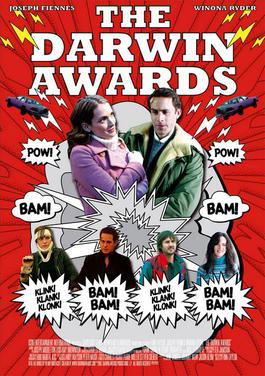
The Darwin Awards

I watched the 2006 movie The Darwin Awards.  It has a scene with the Mythbusters and Metallica.  I thought it was ok, funny in places,  not hilarious like some reviewers were saying.  I’d give it 2.4 out of 5.
[From Wikipedia] The Darwin Awards is a 2006 American adventure comedy film based on the website of the same name written and directed by Finn Taylor, the film premiered January 25, 2006, at the Sundance Film Festival. The film features Joseph FiennesWinona RyderDavid ArquetteJuliette LewisWilmer ValderramaChris PennJulianna MarguliesRobin TunneyLawrence FerlinghettiBrad HuntAdam SavageJamie Hyneman and Metallica. This was Chris Penn‘s last movie before his death on January 24, 2006, the day before the film’s premiere. The film includes several full and partial re-enactments of “Darwin Awards“, the earliest of which were fictitious, most notably the debunked JATO Rocket Car story.
The Darwin Awards are a tongue-in- cheek honour, originating in Usenet newsgroup discussions around 1985. They recognise individuals who have supposedly contributed to human evolution by selecting themselves out of the gene pool via death or sterilisation by their own actions.

Accidental self-sterilisation also qualifies; however, the site notes: “Of necessity, the award is usually bestowed posthumously.” The candidate is disqualified, though, if “innocent bystanders”, who might have contributed positively to the gene pool, are killed in the process. The logical problem presented by award winners who may have already reproduced is not addressed in the selection process due to the difficulty of ascertaining if a person has or does not have children; the Darwin Award rules state that the presence of offspring does not disqualify a nominee[3].The project became more formalized with the creation of a website in 1993, and followed up by a series of books starting in 2000, authored by Wendy Northcutt. The criterion for the awards states, “In the spirit of Charles Darwin, the Darwin Awards commemorate individuals who protect our gene pool by making the ultimate sacrifice of their own lives. Darwin Award winners eliminate themselves in an extraordinarily idiotic manner, thereby improving our species’ chances of long-term survival.”[2]

People who have somehow miraculously survived their suicidal idiocy can be given an “Honourable Mention” if their attempted act of self removal is deemed worthy (and humorous), i.e. they tried their best.

The Darwin Awards books state that an attempt is made to disallow known urban legends from the awards, but some older “winners” have been “grandfathered” to keep their awards. The Darwin Awards site does try to verify all submitted stories, but many similar sites, and the vast number of circulating “Darwin awards” emails, are largely fictional.

[From Wikipedia] The account of the JATO Rocket Car was one of the original Darwin Awards winners: a man who supposedly met his death in a spectacular manner after mounting a JATO unit (a rocket engine used to help heavy aircraft to take off) onto an ordinary automobile. It was originally circulated as a forwarded email.

In 1996, after numerous inquires, the Arizona Department of Public Safety issued a news release posted on their website concerning the story. It termed the story “an Arizona myth.”

The story was also debunked in 2003 on the pilot episode of MythBusters, titled “Jet Assisted Chevy“.

Auto Club 400 – 03/01/20

Watched the Auto Club 400 today.  Alex Bowman wins,  Chase Elliott came in 4th and Kyle Busch finished 2nd.

[From Wikipedia] Auto Club Speedway, formerly California Speedway,[2] is a two-mile (3 km), low-banked, D-shaped oval superspeedway in Fontana, California which has hosted NASCAR racing annually since 1997. It is also used for open wheel racing events. The racetrack is located 47 miles (76 km) east of Los Angeles and is near the former locations of Ontario Motor Speedway and Riverside International Raceway. The track is owned and operated by International Speedway Corporation. The speedway is served by the nearby Interstate 10 and Interstate 15 freeways as well as a Metrolink station located behind the backstretch.

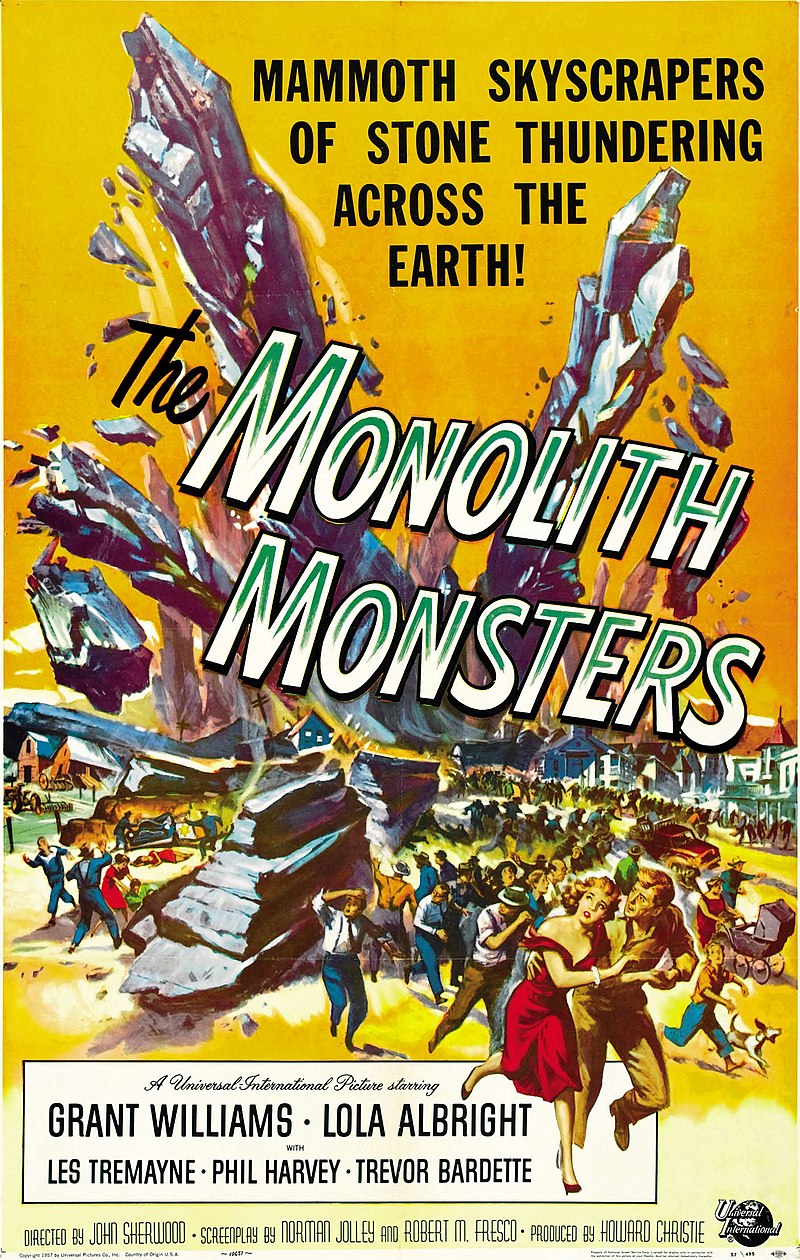
The Monolith Monsters

The Monolith Monsters is a 1957 American black-and-white science fiction film from Universal-International, produced by Howard Christie, directed by John Sherwood, that stars Grant Williams and Lola Albright. The film is based on a story by Jack Arnold and Robert M. Fresco, with a screenplay by Fresco and Norman Jolley.[1]
The Monolith Monsters tells the story of a large meteorite that crashes in a Southern California desert and explodes into hundreds of black fragments which have strange properties. When those fragments are exposed to water, they grow very large and tall. The fragments also begin to slowly petrify some of the inhabitants of a nearby small town. The story that unfolds becomes one of human survival against an encroaching unnatural disaster, that if not stopped, could become a national ecological nightmare that could pose a possible threat to all of humanity.
SPOILER BELOW
In the desert outside of San Angelo, California, a huge meteorite crashes and explodes, scattering hundreds of black fragments over a wide area. The next day, Federal geologist Ben Gilbert (Phil Harvey) brings one of the fragments to his office, where he and local newspaper publisher Martin Cochrane (Les Tremayne) examine it. That night, a strong wind blows over a full water container onto the black rock, starting a chemical reaction.
When Dave Miller (Grant Williams), the head of San Angelo’s district geological office, returns from a business trip, he finds Ben’s corpse in a rock-hard, petrified state and the office’s lab damaged by large rock fragments. Dave’s girlfriend, teacher Cathy Barrett (Lola Albright), takes her students on a desert field trip; young Ginny Simpson (Linda Scheley) pockets a piece of the black meteorite rock, later washing it in a large tub outside her family’s farmhouse. In town Dr. E. J. Reynolds (Richard H. Cutting) performs Ben’s autopsy and cannot explain the body’s condition; he informs Dave and Police Chief Dan Corey (William Flaherty) the body is being sent to a specialist. Martin returns to the wrecked office with Dave where he recognizes the large fragments as the same type of black rock Ben had been examining.
Cathy joins them, also recognizing the fragments. She goes with the two men to the Simpson farm; they find the farmhouse in ruins under a large pile of black rocks and Ginny’s parents dead. The girl is still alive but in a catatonic state. At Dr. Reynolds’ request, they rush her to Dr. Steve Hendricks (Harry Jackson) at the California Medical Research Institute in Los Angeles. He later reports that Ginny is slowly turning to stone; her only hope lies with identifying the black rock within eight hours. Dave brings a fragment to his old college professor, Arthur Flanders (Trevor Bardette), who determines that it came from a meteorite. Back at the Simpson farm, both men notice a discoloration in the ground: The black rock is draining something from everything it touches, including people. Later, tests show that silicon is that substance; in humans it is normally just a trace element. Dr. Reynolds explains that research indicates that one possible function of silicon in the human body is to maintain human tissue flexibility. They suddenly realize that the meteorite’s absorption of silicon was the cause of Ben’s death, Ginny’s condition, and the death of her parents; Steve then prepares and administers a silicon solution injection to the girl.
Returning to the desert, Dave and Arthur trace the fragments to the crashed meteor. Arthur deduces that the meteorite’s atomic structure has been radically altered by the intense heat of atmospheric friction. Back in the lab, a rainstorm blows up while Dave and Arthur continue their investigation. A piece of black rock falls into the sink and begins to react when hot coffee is poured on it; the men then realize that water is the culprit. With it raining outside, they hurriedly return to the desert and see the black fragments now growing into stories-tall monoliths that rise up and then crash back to Earth, breaking into hundreds more fragments, each fragment then repeating that cycle. Dave quickly realizes that the monoliths’ advancing path will take them directly through San Angelo, and from there the monoliths could spread and possibly threaten all life on Earth.
They report and explain the threat to Dan, who then makes plans to evacuate San Angelo. The governor is notified, and declares a state of emergency in the San Angelo area. At the hospital, Ginny finally revives, and Dave deduces that something in the silicon solution will check the fragments’ growth. More locals are soon rushed to Dr. Reynolds’ office in various stages of petrification. With little time left, and the telephone and electricity cut off, the monoliths continue to multiply and advance, soaking up water from the rain-soaked soil. Dave and Arthur struggle to find the correct formula; they finally realize the monoliths can be stopped with a simple saline solution, a part of Steve’s silicon formula.
Dave plans to dynamite the local dam and flood the nearby salt flats, creating a large supply of salt water. Because the dam is private property, however, Dan attempts to contact the governor for permission to blow up the dam. Knowing they must halt the monoliths at the canyon’s edge, Dave acts without waiting for the governor’s approval and the dynamite is detonated. The group watches as a huge torrent of water flows over the salt deposits at the canyon’s edge, reaching the monoliths; their growth is finally halted when the last huge formation of monoliths crashes down into the salty water. Dan reveals to the group that he had finally reached the governor who told him not to blow up the dam, pauses, and adds unless Dave was absolutely certain of success. As they all laugh, Dave then comments, first repeating Martin’s earlier assertion that the region’s salt flat was “Mother Nature’s worst mistake”, then pointing out, ironically, that this near-disaster has just proved otherwise.