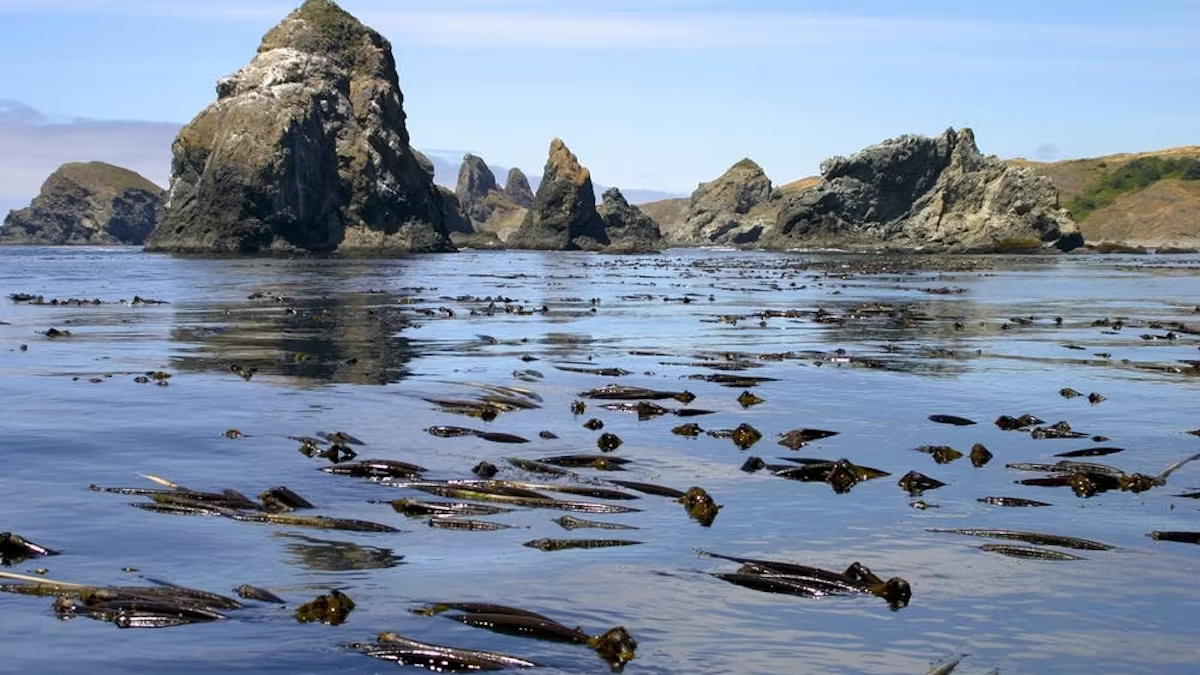

The Kelp Highway Hypothesis is a theory that suggests the earliest human migration to the Americas followed a coastal route along the Pacific Rim, rich in marine resources like kelp forests. This hypothesis presents an alternative to the more traditional Clovis-First Theory and the Beringia Overland Route

by emphasizing the role of maritime ecosystems in supporting early human populations. The Clovis-First Theory long dominated the archaeological narrative, asserting that the first Americans crossed the Bering Land Bridge (Beringia) from Siberia to Alaska during the Last Glacial Maximum, approximately 13,000 years ago.

According to this model, the Clovis people, identified by their distinctive fluted spear points, spread rapidly across North America, following ice-free corridors that opened between massive glaciers. However, as evidence mounted of pre-Clovis settlements, this theory lost its exclusivity. The Beringia Overland Route theory similarly suggests migration across the

Bering Land Bridge but emphasizes inland travel through tundra and grasslands. While this route was feasible during glacial retreats, archaeological evidence now shows that many areas along the corridor were biologically inhospitable for extended periods,

making an alternative path along the Pacific coast more plausible. The Kelp Highway Hypothesis proposes that early migrants moved along the Pacific coast’s rich marine environments, which were teeming with fish, shellfish, and seaweed. The extensive kelp forests provided stable food sources and aided navigation. This route would have been viable as early as 16,000 years ago

when ice sheets had begun retreating, exposing coastal refugia. A key site supporting this hypothesis is Monte Verde in southern Chile. Dating back at least 14,500 years, Monte Verde predates Clovis sites and presents compelling evidence for earlier coastal migration. Artifacts found there, including wooden tools, animal remains, and plant fibers, indicate a well-established human presence, suggesting that the inhabitants may have arrived via a coastal route rather than traversing the interior of North America. Additional support comes from archaeological discoveries along the Pacific coast, including sites on islands off British Columbia and California.
Identified crop remains from Pelagonian Neolithic sites; a, Triticum monococcum (einkorn); b, T. dicoccum (emmer); c, T. timophevii (Timopheev’s wheat); d, T. aestivum/durum/turgidum (naked wheat), node (top view); e, Hordeum distichon (2-row hulled barley); f, Hordeum vulgare var nudum (naked barley); g, Lens culinaris (lentil); h, Pisum sativum (pea); i, Papaver sominferum (opium poppy). scale, a-h, 1 mm; i, 0.25 mm; photos by R. Soteras and A. Sabanov


These sites often feature stone tools designed for fishing and coastal living, reinforcing the idea that early migrants adapted to marine environments rather than relying solely on big-game hunting. Genetic studies further bolster the coastal migration model. Indigenous groups in the Americas carry genetic markers that align with populations from coastal Asia, suggesting an ancestral link to seafaring migrants who navigated the Pacific coastline.

The Kelp Highway Hypothesis offers a compelling alternative to the Clovis-First and Beringia Overland models by demonstrating how early humans could have followed a biologically rich coastal corridor to reach South America well before the Clovis culture emerged. This theory continues to reshape our understanding of human migration into the Americas.
Further Reading


Sources
- National Geographic “Did the First Americans Take a Ride on the Kelp Highway?” https://blog.education.nationalgeographic.org/2017/11/08/did-the-first-americans-take-a-ride-on-the-kelp-highway/
- Wikipedia “Coastal migration (Americas)” https://en.wikipedia.org/wiki/Coastal_migration_(Americas)
- USGS “The kelp highway hypothesis: Marine ecology, the coastal migration theory, and the peopling of the Americas” https://pubs.usgs.gov/publication/70029934
- The Journal of Island and Coastal Archaeology “The Kelp Highway Hypothesis: Marine Ecology, the Coastal Migration Theory, and the Peopling of the Americas” https://werc.ucsc.edu/Estes/Estes%20Publications/Erlandsonetal.CoastalIslarch.pdf
- Roseanne Chambers “The Kelp Highway” https://roseannechambers.com/the-kelp-highway/
- Center for Latin American and Caribbean Studies “Did the First Americans Take a Ride on the Kelp Highway?” https://uwm.edu/clacs/did-the-first-americans-take-a-ride-on-the-kelp-highway/
- Seattle Aquarium “The Kelp Highway” https://salishsea.seattleaquarium.org/kelp/
- ThoughtCo. “Kelp Highway Hypothesis” https://www.thoughtco.com/kelp-highway-hypothesis-171475
