

Flocculants are substances used to encourage fine particles in a liquid to clump together, forming larger aggregates known as flocs. This process is essential in various industries, as it helps separate solid impurities from liquids, making it easier to remove unwanted materials.

Flocculants play a critical role in processes such as water treatment, brewing, and even cheese-making, and understanding their behavior requires insights from chemistry, biology, and engineering. The effectiveness of flocculants is often determined through a practical procedure called a jar test. In this test, multiple jars are filled with identical water samples, and different amounts or types of flocculants are added to each.

By stirring and observing how quickly particles form flocs and settle, operators can identify the optimal flocculant dosage and mixing conditions. The jar test is widely used in water treatment plants to ensure efficient removal of suspended solids without overusing chemicals. From a chemical perspective, flocculants operate through surface and physical chemistry principles.

Particles in liquids often carry an electrical charge, which causes them to repel one another, remaining dispersed. Flocculants neutralize these charges, allowing the particles to come together. In some cases, flocculants contain long-chain molecules that physically bind particles, linking them like a net. This combination of charge neutralization and molecular bridging encourages

the formation of larger flocs that settle faster under gravity. In civil engineering and earth sciences, flocculants are crucial in managing soil and sediment. During excavation, flocculants can be used to clarify muddy water, stabilizing the site and reducing the environmental impact of runoff.

Similarly, in mining, flocculants assist in separating valuable minerals from unwanted materials, improving efficiency in ore processing. In environmental applications, they are employed to control erosion by promoting soil particle cohesion. Biological processes also rely on flocculation, particularly in natural ecosystems.

Some bacteria and algae produce natural flocculants that improve water clarity in lakes and rivers. These biological flocculants function similarly to synthetic ones, helping suspended particles clump and settle. This natural mechanism has inspired eco-friendly solutions in wastewater treatment and other industries. In the cheese-making industry, flocculation is a crucial stage in curd formation. When rennet, an enzyme, is added to milk, it triggers proteins like casein to clump together. Monitoring flocculation timing helps cheesemakers control texture and quality.

Similarly, in brewing, flocculation plays a role when yeast cells gather and settle at the bottom of fermentation tanks. Some yeast strains naturally flocculate, while brewers may also use flocculants to speed the process, improving beer clarity and consistency. Water treatment facilities heavily rely on flocculants to remove impurities from drinking water and wastewater.
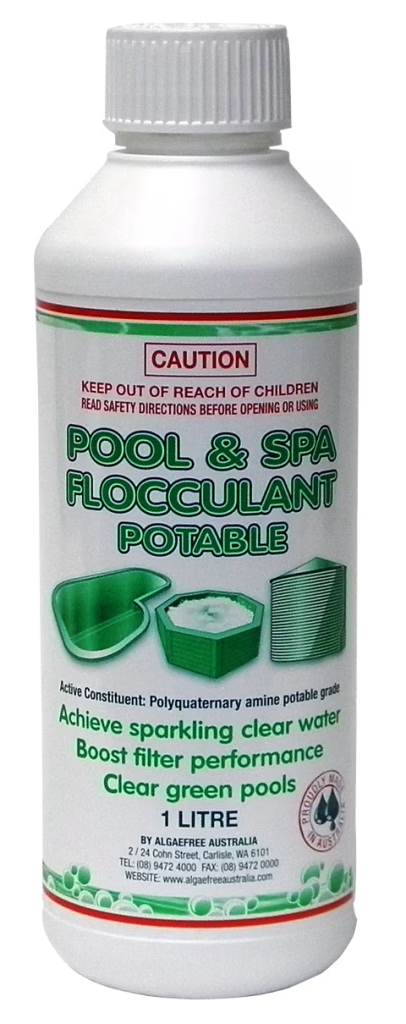
By adding flocculants, contaminants such as dirt, metals, and organic matter form visible clumps that can be easily filtered or allowed to settle out. This step is critical in ensuring safe, clean water for consumption and industrial use. On the other hand, deflocculation refers to the opposite process — intentionally keeping particles dispersed rather than allowing them to clump together. Deflocculants are often used in ceramics, paints, and clay slurries where a smooth, even texture is required. While flocculants promote particle bonding, deflocculants stabilize particle separation, ensuring consistent flow properties in various applications. The versatility of flocculants highlights their importance across disciplines, from ensuring clean drinking water to improving food production.

As industries continue to seek efficient and environmentally friendly solutions, flocculants — particularly natural or biodegradable options — remain a valuable tool in achieving these goals.
Further Reading


Sources
- NetSol Water “What are flocculants and how do flocculants work?” https://www.netsolwater.com/what-are-flocculants-and-how-do-flocculants-work.php?blog=4242
- Enva “Role of Flocculants in Wastewater Treatment” https://enva.com/case-studies/flocculants-in-wastewater-treatment
- Wikipedia “Flocculation” https://en.wikipedia.org/wiki/Flocculation
- ChemReady “What is Flocculation?” https://www.getchemready.com/water-facts/what-is-flocculation/
- ScienceDirect “Flocculant” https://www.sciencedirect.com/topics/engineering/flocculant “Uses of electro-coagulation-flocculation (ECF) for the pre-concentration of microalgae biomass” https://www.sciencedirect.com/science/article/pii/S1359511322003403
- WCS Group “How are coagulants and flocculants used in water and wastewater treatment?” https://www.wcs-group.co.uk/wcs-blog/coagulants-flocculants-wastewater-treatment
- Teach Engineering “Flocculants: The First Step to Cleaner Water!” https://www.teachengineering.org/lessons/view/usf_flocculant_lesson01

Flocculants play a crucial role in water and wastewater treatment by helping to aggregate and settle suspended particles. This process improves water clarity and quality, making it easier to filter and reuse. Their application is essential in industrial, municipal, and environmental settings for efficient solid-liquid separation and sustainable water management.
Swjal Process Pvt. Ltd.