

The Rosetta Stone is one of the most famous and consequential archaeological discoveries in human history, a fragmentary granodiorite stele that became the key to unlocking the long-lost language of ancient Egypt. Carved in 196 BCE during the reign of Ptolemy V Epiphanes, the stone bears a decree issued by Egyptian priests affirming the king’s divine status and generosity. What makes it extraordinary is not the content of the decree itself,

which is fairly typical royal propaganda, but the fact that it is inscribed in three distinct scripts: hieroglyphic, demotic1, and ancient Greek. At the time of its creation, these scripts reflected different layers of Egyptian society, with hieroglyphs reserved for religious and monumental purposes, demotic used for everyday administrative writing, and Greek serving as the language of the ruling

Ptolemaic2 elite descended from Alexander the Great. This trilingual presentation ultimately made the stone a linguistic bridge across centuries of lost knowledge. The “working” of the Rosetta Stone, in a conceptual sense, lies in its function as a comparative text that enabled scholars to decipher Egyptian hieroglyphs, which had been unreadable for nearly 1,400 years. Because the Greek portion

of the inscription was already understood by scholars, it provided a reference point against which the other scripts could be analyzed. Early attempts at decipherment were made by several scholars, but the decisive breakthrough came from Jean-François Champollion in 1822. Champollion realized that hieroglyphs were not purely symbolic but also phonetic, representing sounds as well as ideas.

By comparing repeated names in the Greek text, such as “Ptolemy,” with corresponding cartouches in the hieroglyphic section, he identified phonetic patterns that unlocked the system. This insight transformed hieroglyphs from an inscrutable code into a readable language, opening the entire corpus of ancient Egyptian literature, inscriptions, and history to modern understanding and

effectively founding the discipline of Egyptology. The story of the stone’s discovery is rooted in the geopolitical upheavals of the late eighteenth century. It was unearthed in 1799 by French soldiers under Napoleon Bonaparte during his Egyptian campaign, specifically near the town of Rosetta in the Nile Delta, from which the artifact takes its name. The stone was found by an officer, often identified as Pierre-François Bouchard, while fortifying a structure.

Recognizing its potential importance, French scholars quickly began studying it, but their control over the artifact was short-lived. Following the defeat of French forces by the British, the stone was ceded to Britain under the terms of the Capitulation of Alexandria in 1801.

It was subsequently transported to London, where it has remained ever since as a centerpiece of the British Museum, attracting millions of visitors and serving as a symbol of linguistic discovery. Physically, the Rosetta Stone is incomplete, with its top portion missing, meaning that parts of the hieroglyphic text are lost. Even so, enough remains to demonstrate that the three inscriptions are essentially the
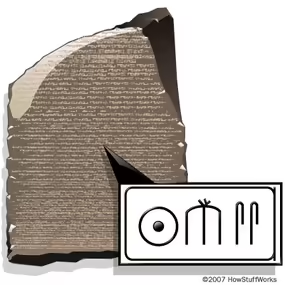
same decree rendered in different scripts. The surviving text reveals a political document that outlines tax remissions, temple benefactions, and honors bestowed upon the king, illustrating how rulers of the Ptolemaic dynasty sought to legitimize their authority within traditional Egyptian religious frameworks.

The stone itself is made of dark granodiorite3, often mistakenly described as basalt, and stands just over three feet tall. Its surface bears the marks of centuries of wear, yet the inscriptions remain remarkably legible, a testament to the durability of both the material and the craftsmanship. Beyond its scholarly importance, the Rosetta Stone has become a cultural icon, its name synonymous with any key that unlocks a complex mystery. Its influence extends far beyond Egyptology into linguistics,

cryptography, and even modern branding, as seen in language-learning software that adopts its name to suggest transformative understanding. The stone also raises ongoing debates about cultural heritage and ownership, with Egypt periodically calling for its repatriation from the British Museum, arguing that it is a central artifact of Egyptian identity. Meanwhile, high-quality casts and digital reproductions have made the text widely accessible,

ensuring that its educational value continues to expand even as its physical custody remains contested. The Rosetta Stone’s legacy ultimately lies in its role as a bridge between worlds separated by time, language, and culture. Before its decipherment, ancient Egypt was largely understood through Greek and Roman accounts, often colored by myth and misunderstanding.

After Champollion’s breakthrough, Egypt began to speak for itself through its own inscriptions, revealing a civilization of immense complexity and continuity. In this sense, the stone is not merely an artifact but a turning point in human knowledge, marking the moment when a lost language was restored and an entire ancient civilization regained its voice.
Footnotes
- Demotic is a late form of the ancient Egyptian writing system that developed around the seventh century BCE as a simplified, highly cursive script derived from earlier hieratic writing, and it was used primarily for everyday purposes such as legal documents, administrative records, letters, and commercial transactions. The term itself comes from the Greek word dēmotikos, meaning “of the people,” reflecting its role as the common script of daily life in contrast to the more formal and religiously associated hieroglyphs. Demotic was widely used throughout the later periods of Egyptian history, especially during the Saite, Persian, and Ptolemaic eras, and it remained in use even into the early Roman period before gradually being replaced by the Coptic alphabet. Linguistically, it represents the Egyptian language in a more evolved stage, capturing phonetic developments that earlier scripts did not fully express, though its highly abbreviated and stylized characters made it difficult for modern scholars to decipher. Its importance is most famously demonstrated on the Rosetta Stone, where the demotic text appears alongside hieroglyphic and Greek versions of the same decree, allowing scholars like Jean-François Champollion to compare the scripts and ultimately unlock the meaning of ancient Egyptian writing as a whole. ↩︎
- Ptolemaic refers to the period, culture, and ruling dynasty of Egypt that followed the conquest of the region by Alexander the Great and was governed by his general Ptolemy I Soter and his descendants from 305 BCE until 30 BCE, when Egypt became part of the Roman Empire after the death of Cleopatra VII. The Ptolemaic era is characterized by a blending of Greek and Egyptian elements, as the Macedonian Greek rulers maintained many traditional Egyptian religious and administrative practices while also introducing Hellenistic culture, language, and political structures. Greek served as the language of government and the elite, while Egyptian continued in everyday and religious contexts, creating a multicultural society that is vividly reflected in artifacts such as the Rosetta Stone, where official decrees were issued in multiple scripts to reach different audiences. The period saw significant developments in art, architecture, and scholarship, particularly centered in Alexandria, which became one of the ancient world’s foremost intellectual centers, housing the famous Library and attracting scholars from across the Mediterranean. Despite its cultural achievements, the dynasty was often marked by internal conflict and reliance on Roman support, which ultimately led to its absorption into the expanding Roman state, marking the end of ancient Egypt as an independent kingdom. ↩︎
- Granodiorite is a coarse-grained intrusive igneous rock that forms deep beneath the Earth’s surface from slowly cooling magma, and it is closely related to granite but contains a higher proportion of plagioclase feldspar relative to potassium feldspar, along with abundant quartz and smaller amounts of dark minerals such as biotite and hornblende, which give it a speckled appearance typically ranging from light gray to darker tones. Because it crystallizes under high pressure over long periods, granodiorite develops a durable, interlocking mineral structure that makes it resistant to weathering and suitable for construction and monumental use, which is why it was chosen for artifacts like the Rosetta Stone. Geologically, granodiorite is commonly associated with continental crust formation, particularly in mountain-building zones where tectonic plate interactions generate large bodies of magma that eventually solidify into batholiths. Its composition places it between granite and diorite on the igneous rock spectrum, reflecting a balance of silica-rich and intermediate mineral content, and its widespread occurrence in ancient geological formations has made it an important material both for scientific study and for human use across history. ↩︎
Further Reading


Sources
- British Museum “Everything you ever wanted to know about the Rosetta Stone” https://www.britishmuseum.org/blog/everything-you-ever-wanted-know-about-rosetta-stone
- American Research Center in Egypt “The Rosetta Stone: Unlocking the Ancient Egyptian Language” https://arce.org/resource/rosetta-stone-unlocking-ancient-egyptian-language/
- National Geographic “How the Rosetta Stone unlocked the secrets of ancient civilizations” https://www.nationalgeographic.com/history/article/how-the-rosetta-stone-unlocked-the-secrets-of-ancient-civilizations
- Khan Academy “The Rosetta Stone” https://www.khanacademy.org/humanities/ancient-art-civilizations/egypt-art/x7e914f5b:late-period-ptolemaic-and-roman-periods/a/the-rosetta-stone
- Wikipedia “Rosetta Stone” https://en.wikipedia.org/wiki/Rosetta_Stone
- How Stuff Works “What Is the Rosetta Stone and Why Is the Artifact Important?” https://science.howstuffworks.com/environmental/earth/archaeology/rosetta-stone.htm
- IFL Science “Site Of Ancient Egyptian “Great Revolt”, Recorded On Rosetta Stone, Finally Discovered” https://www.iflscience.com/site-of-ancient-egyptian-great-revolt-recorded-on-rosetta-stone-finally-discovered-67390
