

Wally Heider’s Studio Three was one of the most important recording rooms of the classic rock era, yet it is often overshadowed by the fame of the larger Wally Heider facilities in both Hollywood and San Francisco. By 1967, Studio Three at Wally Heider Recording in Los Angeles had become a preferred destination for artists seeking a combination of technical excellence and a relaxed creative atmosphere.

Wally Heider himself had already earned a reputation as one of the recording industry’s leading engineers through his pioneering remote recording work, capturing everything from jazz performances to major live rock events. His studios reflected a philosophy that placed musicians first, providing state-of-the-art

equipment while maintaining an environment where artists could experiment freely. Studio Three embodied that approach, offering exceptional acoustics, advanced multitrack recording capabilities, and highly skilled engineers who understood how to translate artistic ideas into finished recordings. The late 1960s and early 1970s represented the studio’s golden age.
Artists
Partial list of known performers
- The 5th Dimension
- Angel
- The Beach Boys
- Betty Davis
- Bob Weir
- Boz Scaggs
- Brewer & Shipley
- Buddy Rich
- Chilliwack
- Coke Escovedo
- The Collage
- Judy Collins
- Crosby, Stills & Nash
- Crosby, Stills, Nash & Young
- Creedence Clearwater Revival
- The Crusaders
- The Byrds
- The Doobie Brothers
- Frank Sinatra
- Frank Zappa
- Gene Clark
- Grace Slick
- Gram Parsons
- Grateful Dead
- Grin
- Harvey Mandel
- Herbie Hancock
- Hot Tuna
- Jackson Browne
- Jack Ashford
- Jefferson Airplane
- Jefferson Starship
- Jerry Garcia
- John Lee Hooker
- Kansas
- Les Brown
- Lindsey Buckingham
- Loggins and Messina
- Minnie Riperton
- Neil Young
- Norman Connors
- Paul Kantner
- Quicksilver Messenger Service
- Reggae Jackson
- Rod Stewart
- Santana (minor overdubs or mixing)
- Stan Kenton
- T. Rex
- The Pointer Sisters
- The Tubes
- Tom Waits
- Van Morrison
- War
- Weather Report
- Wings
- Woody Herman
- Zephyr

At a time when rock music was becoming increasingly sophisticated in both composition and production, Studio Three was frequently used by artists associated with the California sound. Members of Crosby, Stills, Nash & Young, along with numerous session musicians, producers, and engineers, worked within its walls.

The room gained a reputation for recordings that balanced technical precision with the warmth and spontaneity of live performance. Unlike some major-label facilities that imposed rigid schedules and procedures, Wally Heider’s operation encouraged creativity, making Studio Three particularly attractive to musicians who wanted the freedom to experiment with arrangements, overdubs, and emerging recording techniques.
Albums
Partial List
- Atlantic Crossing – Rod Stewart (1975)
- Beach Boys – Wild Honey (1967) – Much of the album was recorded at Studio 3 after the band moved from their home studio.
- Beach Boys – Lei’d in Hawaii (Recorded 1967, Released 2017) – A live-in-the-studio album recorded on September 11, 1967.
- Beach Boys – Smiley Smile (1967) – While primarily recorded at Brian Wilson’s home, the final mixing and some overdubs took place at Studio 3.
- Beach Boys – Stack-O-Tracks (1968) – The instrumental backing tracks album was compiled and mixed here in January 1968.
- Beach Boys – 20/20 (1969) – Included sessions and mixing done at the facility
- Beach Boys – Time to Get Alone – (sessions, 1968–1969)
- Crosby, Stills & Nash – Crosby, Stills & Nash (1969)
- Déjà Vu – Crosby, Stills, Nash & Young (portions, 1970)
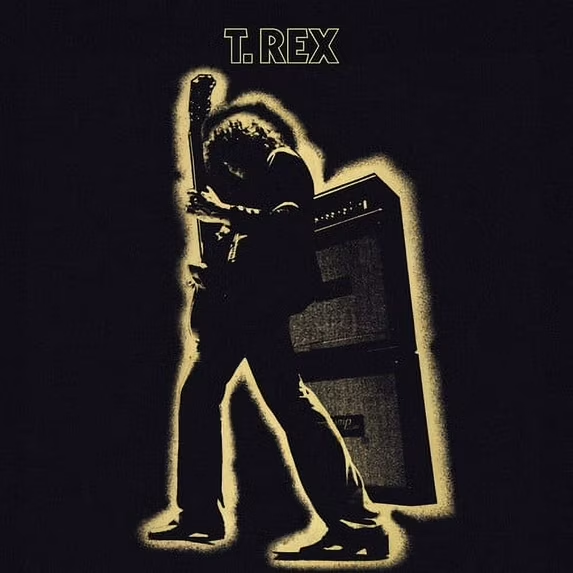
- Electric Warrior – T. Rex (portions, 1971)
- Hotel Sheet – Jack Ashford (mixed, 1970s)
- Kansas – Song for America (1975) – Recorded entirely at the Hollywood location in December 1974
- Law and Order – Lindsey Buckingham (1981)
- Mwandishi – Herbie Hancock (portions/overdubs, 1971) [Note: Primary recording was SF]
- Small Change – Tom Waits (1976)
- Suite: Judy Blue Eyes (Single/Album Track) – Crosby, Stills & Nash (1969)
- Trilogy: Past, Present & Future – Frank Sinatra (portions, 1980)
- Tupelo Honey – Van Morrison (portions/early sessions, 1971) [Note: Primary recording was SF]
- Venus and Mars – Wings (portions, 1975)
- Zephyr – Zephyr (1969)
- Cristo Redentor – Harvey Mandel (1968)
- The Collage – The Collage (1969)

The influence of Studio Three extended beyond the records that were made there. When Wally Heider expanded his operations into San Francisco and opened the Hyde Street complex in 1969, one of the new rooms was deliberately modeled after Studio Three. This reflected Heider’s belief that the room possessed an ideal combination of size,

acoustics, and workflow. As artists moved between Los Angeles and San Francisco during the peak years of the West Coast music scene, the design and operating philosophy of Studio Three helped shape recording practices in both cities. The room became part of a larger network of studios that documented the evolution of folk-rock, country-rock,

singer-songwriter music, jazz fusion, and many other styles that flourished during the period. Throughout the 1970s, Studio Three continued to thrive as recording technology advanced from eight-track to sixteen-track and eventually twenty-four-track systems. The room adapted to these changes without losing the qualities that had made it popular in the first place.

Producers and engineers appreciated its reliability, while artists valued the sense of comfort that allowed them to focus on performance rather than technology. During an era when albums were becoming increasingly ambitious and expensive, Studio Three remained a place where both creativity and craftsmanship could flourish.
The room’s contribution to the sound of the 1970s is difficult to quantify because it was involved in so many projects, but its impact can be heard throughout the decade’s most influential recordings. By the early 1980s, the recording industry was changing rapidly. New ownership structures, evolving technologies,

and economic pressures transformed many of the legendary independent studios that had defined the previous generation. Wally Heider’s original empire gradually gave way to new operators and new business models, and by 1984 the era most closely associated with Studio Three had effectively come to an end.

Yet the studio’s legacy remains secure. It represented a period when recording studios were becoming creative instruments in their own right, and when engineers, producers, and musicians worked together to push the boundaries of what recorded music could achieve. Between 1967 and 1984, Studio Three stood as one of the premier creative spaces in American popular music, helping to capture performances that continue to influence artists and listeners decades later.
Further Reading


Sources
- Wikipedia “Wally Heider” https://en.wikipedia.org/wiki/Wally_Heider
- UMass Amherst https://credo.library.umass.edu/
- Hindsight Records “Wally Heider” https://www.hindsightrecords.com/blog/s8wtmkgmsbr9trzw6fhsrssxzmxd25
