

I have decided to create a new Doyle’s Space: Music Hall of Fame award known as the Shining Star Award. It will be awarded to bands/artists that I love, that may not as be well known, maybe from smaller musical markets, with catalogs not as deep as some of other artists such as the Beatles, Rolling Stones, Elton John, Michael Jackson, or Prince.

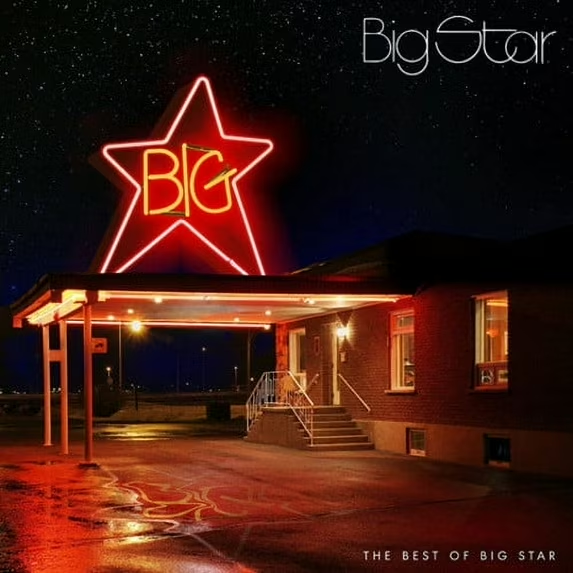
I wanted to honor these artists here, probably with a less extensive, but still inclusive post. My first inductee here will be a band I learned of when one of my favorite bands, the Bangles, covered one of their songs. I picked up their “September Gurls” EP and fell in love with their sound. Big Star was one of the most influential bands in rock history despite achieving only

modest commercial success during its original lifetime. Formed in Memphis, Tennessee, in 1971, the group emerged from the city’s vibrant musical culture centered around Ardent Studios. Guitarist and songwriter Chris Bell had been playing with a local band called Icewater alongside bassist Andy Hummel and drummer Jody Stephens when former Box Tops vocalist Alex Chilton entered the picture. The four musicians quickly

discovered a shared love of British Invasion pop, especially the Beatles, as well as American rock, soul, and folk music. The band adopted the name Big Star from a local grocery chain and set out to create melodic, guitar-driven songs that blended catchy hooks with emotional depth. Although their records sold poorly due in part to distribution problems and a lack of promotional support, Big Star’s music eventually became a blueprint for power pop, alternative rock, indie rock, and jangle pop, influencing generations of musicians long after the group’s initial breakup.

Alex Chilton was the band’s most recognizable member when Big Star formed. Having achieved teenage stardom as the lead singer of The Box Tops and their hit “The Letter,” Chilton brought professional experience and a distinctive voice to the group. As a songwriter, he balanced melodic accessibility with emotional complexity, creating songs that ranged from tender

ballads to experimental and deeply personal works. Following Big Star’s collapse, Chilton pursued a critically admired solo career and became an influential figure in underground rock. His unpredictable artistic choices only enhanced his reputation as a cult icon. He died on Wednesday, March 17, 2010, but remains one of the most respected singer-songwriters of his generation.

Chris Bell was the band’s co-founder, musical architect, and perhaps its most overlooked genius. His songwriting and guitar work were central to Big Star’s earliest recordings, and his partnership with Chilton was frequently compared to famous songwriting duos because of the complementary nature of their talents. Bell’s songs often explored themes of spirituality, longing,

and personal uncertainty while featuring intricate harmonies and ringing guitars. Frustrated by the commercial failure of Big Star’s debut album, he left the band shortly after its release. Bell later recorded solo material that was released posthumously and earned widespread acclaim. Tragically, he died in an automobile accident on Wednesday, December 27, 1978, one day before his twenty-eighth birthday.

Andy Hummel served as bassist, songwriter, and occasional vocalist. Though sometimes overshadowed by Bell and Chilton, Hummel made significant contributions to Big Star’s sound and repertoire. His melodic bass playing helped anchor the band’s sophisticated arrangements, while songs such as

“The India Song” and “Way Out West” demonstrated his songwriting abilities. After leaving the music business, he pursued a professional career outside of rock music but remained connected to Big Star’s legacy. He died on Monday, July 19, 2010.

Jody Stephens was the band’s drummer and one of its most dependable musical forces. His tasteful drumming provided both energy and subtlety, helping shape the band’s distinctive blend of pop precision and rock intensity. Stephens also contributed vocals and songwriting, especially during the band’s later years when personnel changes altered the group’s dynamics.

Following the deaths of his fellow founding members, Stephens became the last surviving original member of Big Star and has worked tirelessly to preserve and celebrate the band’s legacy through performances, archival projects, and his leadership role at Ardent Studios.

Big Star’s debut album, #1 Record, was released in 1972 and is now widely considered one of the greatest power-pop albums ever made. Ironically, despite its optimistic title, the album sold very poorly. Songs such as “The Ballad of El Goodo,” “Thirteen,” “When My Baby’s Beside Me,” and “Watch the Sunrise” showcased the remarkable

songwriting partnership of Bell and Chilton. Critics praised the album’s lush harmonies, melodic craftsmanship, and emotional sincerity, but distribution problems prevented it from reaching a large audience. Decades later, it became a landmark recording whose influence far exceeded its original commercial performance.


The group’s second album, Radio City, arrived in 1974 after Bell’s departure. Driven largely by Chilton, Hummel, and Stephens, the album featured a slightly tougher and more energetic sound while retaining the melodic brilliance of its predecessor. Songs such as “September Gurls,”

“Back of a Car,” and “O My Soul” have since become classics of the power-pop genre. Like its predecessor, Radio City was critically admired but commercially unsuccessful. Over time, however, many critics came to regard it as one of the finest rock albums of the 1970s.


The band’s third album, commonly known as Third or Third/Sister Lovers, had a far more troubled history. Recorded primarily in 1974 with producer Jim Dickinson, the sessions reflected the band’s internal disintegration and Chilton’s increasingly experimental artistic direction.

The resulting material was darker, more fragmented, and emotionally raw than anything Big Star had previously recorded. Songs such as “Holocaust,” “Kanga Roo,” and “Take Care” revealed a haunting vulnerability rarely heard in rock music. The album was not widely released until several years after it was recorded, and different versions appeared under various titles.

Today it is regarded as a masterpiece of artistic expression and one of the most influential cult albums in rock history. The aforementioned “September Gurl” EP was released in 1987 by Line Records, on white vinyl, in Germany. It also contained “She’s A Mover”, “Don’t Lie To Me”, and “When My Baby’s Beside Me”.


After nearly two decades of inactivity, Big Star reunited in 1993 when Chilton and Stephens joined forces with Jon Auer and Ken Stringfellow of The Posies. The revived lineup toured successfully and introduced the band’s music to new audiences. In 2005, the reunited group released In Space, the first new Big Star studio album in more than thirty years.

Although it never achieved the legendary status of the original trilogy, it was generally well received and demonstrated that the band could still create engaging music. Big Star’s singles never became major hits during the band’s original existence, but many have since become enduring favorites among music enthusiasts.

“September Gurls” is often considered the group’s signature song and has been covered by numerous artists. “In the Street” gained renewed fame when a version of the song became the theme for the television series That ’70s Show. Other beloved tracks include “The Ballad of El Goodo,” “Thirteen,” “When My Baby’s Beside Me,”
“Don’t Lie to Me,” and “Watch the Sunrise.” Many of these songs have been reinterpreted by artists ranging from alternative rock bands to singer-songwriters, demonstrating the lasting appeal of Big Star’s catalog. The band’s influence on later musicians is almost impossible to overstate. Artists and groups such as R.E.M., The Replacements, Teenage Fanclub, The Bangles,

and countless others have cited Big Star as a formative influence. Their combination of melodic songwriting, emotional honesty, jangling guitars, and independent spirit helped shape alternative rock decades before that term became common. What once seemed like commercial failure ultimately became one of rock music’s most remarkable

success stories, as generations of musicians discovered and celebrated a band that had been ahead of its time. Recognition for Big Star has steadily grown over the decades. Big Star: Nothing Can Hurt Me is a 2012 documentary that chronicles the remarkable story of the influential Memphis rock band Big Star, a group whose commercial failures during the

1970s stand in stark contrast to the immense artistic reputation they later achieved. Directed by Drew DeNicola and Olivia Mori, the film examines the band’s origins at Ardent Studios in Memphis and follows the careers of Alex Chilton, Chris Bell, Andy Hummel, and Jody Stephens as they created music that would eventually become foundational to power pop, alternative rock, and indie music.

Their albums frequently appear on lists of the greatest records ever made, and #1 Record was inducted into the Grammy Hall of Fame in 2025. The band was also inducted into the Memphis Music Hall of Fame in 2014. Numerous documentaries, books, tribute concerts, and archival releases have further cemented their reputation.

Today, Big Star is widely regarded as one of the defining cult bands in rock history, a group whose artistic impact dramatically exceeded its commercial success and whose music continues to inspire listeners and musicians more than fifty years after its formation.
Further Reading


Sources
- Wikipedia “Big Star” https://en.wikipedia.org/wiki/Big_Star “Number 1 Record” https://en.wikipedia.org/wiki/Number_1_Record “Radio City (album)” https://en.wikipedia.org/wiki/Radio_City_(album) “Third/Sister Lovers” https://en.wikipedia.org/wiki/Third/Sister_Lovers “In Space” https://en.wikipedia.org/wiki/In_Space
- 45 Cat https://www.45cat.com/
- Discogs “Big Star” https://www.discogs.com/artist/270582-Big-Star
- Allmusic “Big Star” https://www.allmusic.com/artist/big-star-mn0000051992
- Stax “Big Star” https://staxrecords.com/artist/big-star/
- uDiscover Music “Big Star” https://www.udiscovermusic.com/artist/big-star/
