

The Mandalorian and Grogu is a 2026 American science fiction adventure film that continues the story begun in the Disney+ series The Mandalorian and marks the first theatrical Star Wars feature film released since Star Wars: The Rise of Skywalker (2019). Released on May 22, 2026, the film was directed by Jon Favreau, who also co-wrote the screenplay with Dave Filoni and Noah Kloor. Favreau also served as one of the producers alongside Kathleen Kennedy, Dave Filoni, and Ian Bryce,

while Ludwig Göransson returned to compose the musical score after his acclaimed work on the television series. Conceived as both a continuation for longtime fans and a standalone adventure for newcomers, the film expands the story of Din Djarin and his adopted apprentice Grogu from streaming television to the cinematic scale. The movie was filmed specifically for IMAX presentation, with Lucasfilm emphasizing larger action sequences, more elaborate visual effects,
and an expanded sense of scope while maintaining the intimate relationship between its two central characters. The story takes place during the New Republic era after the fall of the Galactic Empire. Although Emperor Palpatine’s regime has been defeated, numerous Imperial warlords continue to threaten peace across the galaxy. Din Djarin, now working with the fledgling New Republic, is enlisted for dangerous missions that require his unique combination of combat skills,

resourcefulness, and Mandalorian honor. Grogu, meanwhile, continues to mature and develop his abilities in the Force while learning practical survival skills from his adoptive father. Rather than presenting another galaxy-wide conflict, the film centers on a more personal

adventure that explores the evolving bond between the two protagonists as they encounter new allies, dangerous enemies, and remnants of the Empire attempting to regain influence. Sigourney Weaver joins the franchise as Colonel Ward, a senior New Republic officer,

while Jeremy Allen White provides the voice of Rotta the Hutt, bringing back a character last seen as a child during Star Wars: The Clone Wars. Jonny Coyne portrays one of the surviving Imperial warlords who opposes the New Republic’s efforts.
Cast
- Pascal, Pedro (April 2, 1975) – Din Djarin / The Mandalorian, the armored Mandalorian bounty hunter whose deep bond with Grogu remains the emotional center of the story as he undertakes dangerous missions on behalf of the New Republic while confronting Imperial remnants across the galaxy. Pascal is best known for his roles as Oberyn Martell in Game of Thrones, Javier Peña in Narcos, Joel Miller in The Last of Us, Maxwell Lord in Wonder Woman 1984, and as the title character in the Disney+ series The Mandalorian.
- White, Jeremy Allen (February 17, 1991) – Rotta the Hutt, the son of Jabba the Hutt, returning as an adult after first appearing as an infant in Star Wars: The Clone Wars. White provides the character’s voice performance. He previously starred as Phillip “Lip” Gallagher in Shameless, Carmy Berzatto in The Bear, and has appeared in films including The Iron Claw, The Rental, Fingernails, and Afterschool.
- Coyne, Jonny (January 19, 1958) – Janu Coin, a ruthless Shakari crime lord who leads a powerful faction of Galactic Empire remnants and serves as one of the film’s principal antagonists. Coyne previously appeared in Alcatraz, Turn: Washington’s Spies, The Blacklist, Preacher, The Walking Dead, The X-Files, and the films Gangster Squad and The Accountant.
- Scorsese, Martin (November 17, 1942) – Hugo Durant, an Ardennian fry cook whose unexpected role provides one of the film’s memorable cameo appearances. Although world-famous as the Academy Award-winning director of films such as Taxi Driver, Raging Bull, Goodfellas, Casino, The Departed, The Wolf of Wall Street, and Killers of the Flower Moon, Scorsese has occasionally acted in films including Quiz Show, Shark Tale, and Dreams.
- Weaver, Sigourney (October 8, 1949) – Colonel Ward, the commanding officer of the New Republic’s Adelphi Rangers and a former Rebel Alliance pilot who recruits Din Djarin for critical assignments. Weaver is renowned for portraying Ellen Ripley in the Alien series and has also starred in Ghostbusters, Ghostbusters II, Avatar, Avatar: The Way of Water, Gorillas in the Mist, Working Girl, Galaxy Quest, and The Village.
- Blum, Steve (April 29, 1960) – Voice of Garazeb “Zeb” Orrelios, the veteran Lasat pilot serving the New Republic, reprising the role he originated in previous Star Wars animated productions. Blum is one of the industry’s most prolific voice actors, with notable roles in Star Wars Rebels, Cowboy Bebop, Wolverine and the X-Men, Transformers: Prime, Ben 10, and numerous video games.
- Henderson, Shirley (November 24, 1965) – She voiced members of the Anzellan species. Henderson is well known for playing Moaning Myrtle in the Harry Potter films, Gail in Trainspotting and T2 Trainspotting, Jude in the Bridget Jones films, and appearances in Doctor Who, Happy Valley, and See How They Run.
- Henderson, Stephen McKinley (August 31, 1949) – Voice of the Fisherman (identified offscreen as Gatori), a minor but memorable character encountered during the adventure. Henderson is known for roles in Dune, Civil War, Lady Bird, Fences, Manchester by the Sea, Beau Is Afraid, Devs, and The Newsroom.
- Madera, Hemky (January 26, 1977) – Empire Commander Barro, an Imperial officer serving among the scattered remnants of the fallen Empire. Madera previously appeared as Ignacio in Weeds, Captain Diaz in Spider-Man: Homecoming, and in Dexter, Ash vs Evil Dead, Queen of the South, Blue Bloods, and The Lost City.
- Willig, Matthew (January 21, 1969) – Hogsbreth, the imposing henchman employed by crime lord Janu Coin. A former professional football player, Willig has appeared in We’re the Millers, Birds of Prey, Concussion, Agents of S.H.I.E.L.D., NCIS, Brooklyn Nine-Nine, and numerous other film and television productions.

Development of the film represented a significant shift in Lucasfilm’s plans. Early intentions reportedly called for a fourth season of The Mandalorian, but the ongoing Hollywood labor strikes and Lucasfilm’s evolving theatrical strategy led the creative team to reshape many of those ideas into a feature film instead. Jon Favreau and Dave Filoni viewed the transition as an opportunity to tell a larger story without abandoning the episodic spirit

that made the television series successful. The screenplay was therefore designed to reward longtime viewers while remaining accessible to audiences unfamiliar with every episode of the streaming series. Noah Kloor joined Favreau and Filoni as a screenwriter, contributing to a script that balanced action,

humor, emotional character moments, and traditional Star Wars mythology. Principal photography began in California during 2024, primarily at Manhattan Beach Studios, where Lucasfilm once again relied heavily on StageCraft, the groundbreaking virtual

production system developed for The Mandalorian. Instead of relying exclusively on conventional green-screen techniques, enormous LED walls displayed photorealistic digital environments in real time,

allowing actors and filmmakers to work within immersive virtual sets. While the television series pioneered this technology, the filmmakers expanded its capabilities for theatrical presentation by combining StageCraft with more extensive location photography, larger physical sets, enhanced digital environments, and higher-resolution visual effects suitable for IMAX exhibition. California also benefited from state film production incentives, making it possible to complete much of the production within the state while maintaining the ambitious visual scale expected from a modern Star Wars film.
Anthony Daniels, who played C-3PO in previous Star Wars films, has a voice cameo as an air traffic control droid.

As with the television series, Pedro Pascal reprises his role as Din Djarin, although much of the armored physical performance was again shared with longtime stunt performers Brendan Wayne and Lateef Crowder, allowing multiple units to work simultaneously while

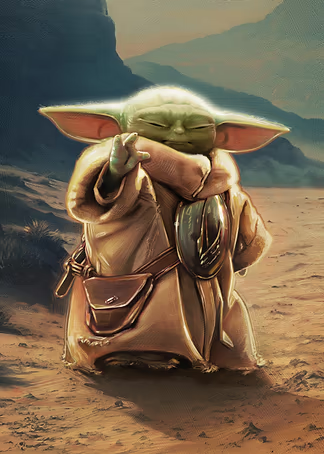
maintaining consistency in the character’s movements and action sequences. Grogu continued to be portrayed through an advanced combination of puppetry, animatronics, visual effects, and digital enhancements, preserving the tactile realism that helped make the character

one of the franchise’s most beloved creations. The production also featured a blend of practical creature effects and computer-generated imagery, following Lucasfilm’s philosophy of combining traditional filmmaking techniques with cutting-edge technology.

One of the film’s greatest strengths lies in its continued exploration of the relationship between Din Djarin and Grogu. Rather than treating Grogu simply as comic relief or a merchandising phenomenon, the filmmakers continue to develop

him as a growing student who gradually becomes more capable while still retaining the innocence that endeared him to audiences. Jon Favreau has frequently described the story as fundamentally being about parenthood, responsibility, mentorship, and sacrifice, themes that remain central even

amid spectacular space battles and large-scale action sequences. This emotional foundation distinguishes the film from many other entries in the franchise, emphasizing character relationships over galactic politics. Upon release, The Mandalorian and Grogu received mixed-to-positive reviews from critics. Many praised Pedro Pascal’s vocal performance, Ludwig Göransson’s musical score, the film’s visual effects, and the continued chemistry between Din Djarin and Grogu. Reviewers also admired the IMAX presentation and the seamless evolution of StageCraft technology.

Some critics, however, felt the story retained the pacing of a television series rather than fully embracing the structure of a standalone feature film, suggesting that portions of the narrative reflected its origins as material originally conceived for a fourth season. Audience reactions were generally warmer than those of critics, particularly among fans of the Disney+ series, many of whom appreciated seeing the characters make the transition to the big screen while preserving the tone that had made the original show such a success. Several interesting pieces of trivia surround the production.

The film represents the first theatrical Star Wars feature released in nearly seven years and serves as Grogu’s first appearance in a cinema after becoming one of popular culture’s most recognizable characters through streaming television. It is also the first Star Wars film to be written jointly by Jon Favreau, Dave Filoni, and Noah Kloor, reflecting Lucasfilm’s collaborative approach to expanding the franchise.

Sigourney Weaver’s casting brought another iconic science fiction veteran into the Star Wars universe, while Jeremy Allen White’s portrayal of Rotta the Hutt reintroduced a character absent from the franchise for many years. The production further demonstrated how

virtual production technology has matured since The Mandalorian premiered in 2019, showcasing techniques that continue to influence filmmaking throughout the entertainment industry. Above all, The Mandalorian and Grogu illustrates Lucasfilm’s effort to bridge the gap between streaming storytelling and theatrical spectacle, using familiar characters and cutting-edge filmmaking technology to launch a new chapter in the ongoing Star Wars saga.
Further Reading


Sources
- Wikipedia “The Mandalorian and Grogu” https://en.wikipedia.org/wiki/The_Mandalorian_and_Grogu
- IMDB “Star Wars: The Mandalorian and Grogu – Original title: The Mandalorian and Grogu 2026 PG-13 2h 12m” https://www.imdb.com/title/tt30825738/
- Rotten Tomatoes “Star Wars: The Mandalorian and Grogu PG-13, Now Playing, 2h 12m, Sci-Fi/Adventure/Action/Fantasy” https://www.rottentomatoes.com/m/star_wars_the_mandalorian_and_grogu
