

“I Get By” is a song by Stealers Wheel from the group’s self-titled debut album, released in late 1972, and is one of several album tracks that showcased the songwriting talents of Joe Egan beyond the band’s internationally famous hit “Stuck in the Middle with You.” Written solely by Egan, the song blends folk rock, soft rock, and roots rock influences with a relaxed but confident groove,

featuring Egan’s melodic songwriting style, warm vocal harmonies, and the polished production of the legendary American team of Jerry Leiber and Mike Stoller. Recorded at Apple Studios in London during the sessions for the band’s debut LP, the track also features notable guitar work by Luther Grosvenor, who contributed lead guitar on the recording.

Lyrically, “I Get By” reflects a recurring theme in Egan’s writing: perseverance through uncertainty and life’s everyday struggles, presenting an optimistic outlook built on quiet resilience rather than grand declarations. Rather than telling a linear story, the song paints the picture of someone continuing to move forward despite setbacks, making its message broadly relatable.

The song gained additional exposure when Stealers Wheel performed it on the BBC television program The Old Grey Whistle Test in November 1972, helping establish it as one of the stronger deep cuts from the album. Over the years, “I Get By” has remained a favorite among dedicated fans of the band and admirers of Gerry Rafferty and Joe Egan’s early work,

appearing on various reissues and compilation albums while continuing to receive airplay on album-oriented and classic rock programming. Unlike “Stuck in the Middle with You” or “Late Again,” it has never achieved significant commercial recognition or prominent chart rankings, but critics and listeners have often praised it as an excellent example of Egan’s underrated songwriting abilities.

The song has not generated a substantial number of officially released cover versions, remaining closely associated with the original Stealers Wheel recording, although it has occasionally been interpreted by local artists and tribute performers. Today, “I Get By” is regarded as an overlooked gem within the Stealers Wheel catalog,

illustrating the musical depth of a debut album that offered far more than its best-known hit and highlighting Joe Egan’s gift for crafting melodic, thoughtful songs that have aged gracefully.

“Sunny Afternoon” is a song by the Kinks written solely by Ray Davies and released as a single in June 1966, becoming one of the defining recordings of the British Invasion and one of the band’s greatest achievements. Inspired in part by Davies’ observations of Britain’s changing social climate, his own experiences with sudden wealth and the heavy tax burden imposed on top earners in the United Kingdom during the 1960s,

the song combines satirical humor with themes of financial decline, class resentment, and reluctant acceptance. Its narrator is an aristocratic wealthy man whose fortune is slipping away through taxes and misfortune, yet who ultimately resigns himself to enjoying a lazy summer afternoon with “ice-cold beer,” creating a sharp contrast between melancholy lyrics and an irresistibly relaxed melody.

Musically, “Sunny Afternoon” marked a stylistic departure from the Kinks’ earlier hard-driving rock sound, incorporating elements of music hall, baroque pop, folk rock, and British pop, highlighted by Nicky Hopkins’ distinctive honky-tonk-style piano, Ray Davies’ understated vocal delivery, and the band’s restrained, sophisticated arrangement.

Produced by Shel Talmy and recorded at Pye Studios in London during a particularly creative period for the group, the single became an enormous commercial success, reaching No. 1 on the UK Singles Chart, where it displaced the Beatles’ “Paperback Writer,” while also reaching the Top 20 on the Billboard Hot 100 in the United States and charting highly in numerous other countries.

It later appeared on the Kinks’ 1966 album Face to Face in the United Kingdom and on various international compilations. The song has consistently ranked among the greatest recordings of the rock era, appearing in numerous critics’ polls and publications, including Rolling Stone’s lists of the greatest songs of all time,

and it remains one of Ray Davies’ signature compositions. “Sunny Afternoon” has been covered by a wide variety of artists over the decades, including Joe Cocker, Squeeze, Jimmy Buffett, Me First and the Gimme Gimmes, and other performers from rock, pop, and easy listening backgrounds, demonstrating the song’s remarkable versatility. It has also appeared in numerous films, television programs,

commercials, and documentaries, further cementing its cultural impact. Today, “Sunny Afternoon” is widely regarded as one of the Kinks’ masterpieces, praised for its clever social commentary, memorable melody, and timeless blend of wit and wistfulness, and it continues to be celebrated as one of the finest examples of Ray Davies’ extraordinary songwriting talent and one of the landmark singles of 1960s British popular music.

“Pinch Me” is a song by Barenaked Ladies written by Steven Page and Ed Robertson and released on August 7, 2000, as the lead single from the band’s fifth studio album, Maroon. Produced by Don Was, the recording blends alternative rock, pop rock, and folk-pop with the band’s trademark wit and sophisticated musicianship while presenting a deceptively

upbeat sound that masks introspective and melancholy themes. Ed Robertson has explained that he was initially reluctant to finish the song because he feared its rapid-fire vocal phrasing would invite comparisons to the band’s earlier smash hit “One Week,” but once completed it became one of his favorite compositions, and the record label strongly supported it as the album’s first single.

The song’s memorable guitar riff was inspired by Sheryl Crow’s “Leaving Las Vegas,” while the recording also incorporates a loop created from drummer Tyler Stewart’s performance. Lyrically, “Pinch Me” explores feelings of emotional detachment, aimlessness, and the desire to escape everyday routines, with ordinary suburban imagery contrasting against an underlying sense of existential uncertainty.

The recurring plea, “Pinch me, ’cause I’m still asleep,” serves as a metaphor for feeling disconnected from reality or hoping that life’s disappointments are only a dream, giving the song emotional depth beneath its catchy melody. Commercially, “Pinch Me” became one of the group’s biggest international successes, reaching No. 4 in Canada,

No. 15 on the Billboard Hot 100 in the United States, and No. 2 on Billboard’s Adult Top 40 and Adult Alternative Airplay charts, making it the band’s final Top 40 pop hit in the U.S. It also received extensive airplay on modern rock, adult contemporary, and pop radio while its humorous music video further increased the song’s visibility.

Although it has not generated a large number of high-profile cover versions, it has remained a staple of the band’s live performances and has appeared on greatest-hits collections and anniversary editions of Maroon. Critics praised its intelligent songwriting, memorable chorus, and ability to balance humor with genuine emotional vulnerability, and in retrospect many listeners have come to regard

it as a subtle portrayal of depression, burnout, and the search for meaning hidden beneath an outwardly cheerful façade. Today, “Pinch Me” is widely considered one of Barenaked Ladies’ signature recordings of the post-Stunt era and remains one of the band’s most enduring and emotionally resonant songs.

“The Lazy Song” is a song by Bruno Mars written by Bruno Mars, Philip Lawrence, Ari Levine, and Keinan “K’naan” Warsame and produced by The Smeezingtons for Mars’ debut studio album, Doo-Wops & Hooligans (2010), before being released as the album’s third single on February 15, 2011. Born from a songwriting session during which Mars and his
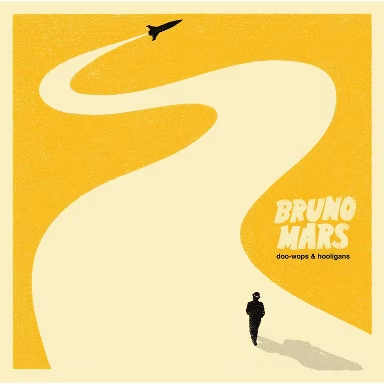
collaborators became frustrated from trying too hard to create something extraordinary, the song emerged after Mars spontaneously remarked that he did not feel like doing anything, a sentiment that became the foundation of its instantly recognizable chorus. Musically, it blends reggae, reggae-pop, ska, and acoustic pop influences into a laid-back,

carefree groove that perfectly complements its humorous lyrics. The song celebrates the simple pleasure of taking a day off from work, responsibilities, and social expectations, using exaggerated scenarios and tongue-in-cheek humor to express the universal desire to relax without guilt, and while some listeners interpret it merely as a novelty song,

others see it as a lighthearted commentary on modern burnout and the need for occasional mental breaks. A notable distinction exists between the album version and the hit single version, with the single featuring the famous whistled melody absent from the original album recording, making both versions immediately recognizable to fans. Commercially, “The Lazy Song” became one of Bruno Mars’ biggest international hits, reaching No. 1 in the United Kingdom and several other countries,

peaking at No. 4 on the Billboard Hot 100 in the United States, and earning multi-platinum and diamond certifications in numerous markets. Its wildly popular music video, featuring Mars and dancers wearing chimpanzee masks performing playful choreography around a bedroom, became one of the defining viral music videos of the early YouTube era and helped cement the song’s worldwide popularity. Although some contemporary critics viewed it as a lightweight follow-up to Mars’ earlier singles,

audiences embraced its infectious melody and relatable message, and it has since become one of his signature recordings. The song has inspired numerous cover versions by professional and amateur performers alike, has been featured in television programs, films, commercials, and sporting events, and continues to rank among Bruno Mars’ most streamed and best-known songs. More than a decade after its release, “The Lazy Song” remains an enduring pop anthem whose cheerful simplicity, memorable chorus, and universal appeal have made it one of the defining feel-good singles of the 2010s.

“Lazy Bones” is a song by Green Day written primarily by Billie Joe Armstrong, with music credited to the band’s members, and released on November 9, 2012, as the fourth track on the group’s tenth studio album, ¡Dos!, the second installment of the ambitious ¡Uno! ¡Dos! ¡Tré! trilogy. Produced by Rob Cavallo and Green Day, the song blends punk rock, garage rock,

and power pop with a darker emotional tone than much of the trilogy, pairing energetic guitars and a memorable chorus with lyrics that reveal exhaustion, depression, irritability, and emotional isolation. Armstrong has acknowledged that the song was deeply personal, reflecting his deteriorating mental and physical condition during the period leading up to his entry into rehabilitation in 2012,

making it one of the most autobiographical songs in Green Day’s catalog. Lyrically, the narrator feels trapped in a cycle of fatigue, anxiety, and self-medication, rejecting sympathy and honesty from others while simply longing for peace of mind, and lines such as “I’m too tired to be bored, I’m too bored to be tired” capture the contradictory emotions often

associated with depression and burnout. Although never released as a commercial single and therefore not a charting hit, “Lazy Bones” has become one of the most critically reassessed tracks from the trilogy, with many fans and reviewers praising its raw honesty and emotional vulnerability. The song later received the “Otis Big Guitar Mix” treatment on the 2020 Otis Mixes EP, providing an alternate version that emphasizes its guitar-driven

arrangement while retaining the original vocal performance. Live performances have been extremely rare, adding to the song’s status as something of a hidden gem within the Green Day catalog. While it has not inspired many notable commercial cover versions, it has developed a devoted following among fans who regard it as one of the trilogy’s standout tracks and one of Armstrong’s finest lyrical achievements.

In retrospect, “Lazy Bones” is frequently cited as foreshadowing the personal struggles that culminated in Armstrong’s rehabilitation shortly after the album’s release, giving the song an emotional weight that has only grown with time and elevating it from a relatively overlooked album cut to one of Green Day’s most candid and affecting explorations of mental exhaustion and recovery.

“There’s No Other Way” is a song by Blur written by Damon Albarn, Graham Coxon, Alex James, and Dave Rowntree, and released in February 1991 as the second single from the band’s debut album Leisure. Produced by Stephen Street, who played a key role in shaping Blur’s early sound, the track marked the group’s first major breakthrough,

combining elements of Madchester, alternative rock, indie pop, and neo-psychedelia with a hazy, dance-influenced groove that set it apart from many of its contemporaries in the emerging Britpop scene. Lyrically, the song is often interpreted as reflecting themes of escapism, youthful aimlessness, and detachment, with ambiguous lines that suggest a state of drifting

through social scenes and nightlife culture without clear direction, which aligned with early-1990s British rave and club culture aesthetics. The single exists in several versions, including the album version, radio edit, and various extended and remixed forms issued across different UK and international releases, which emphasized its rhythmic and atmospheric qualities for club play.

Commercially, it became Blur’s first Top 10 hit in the United Kingdom, peaking at No. 8 on the UK Singles Chart, and helped establish the band as one of the leading new acts of the early 1990s indie scene. While not typically ranked among their later Britpop-era classics such as “Parklife” or “Girls & Boys,” it is frequently credited as an

important stepping stone in their development, laying the groundwork for the stylistic evolution that would define their mid-1990s success. The song has not generated a large number of prominent cover versions, but it remains a staple of compilations and retrospective collections of early Blur material, and is often revisited by fans as a defining snapshot of the band’s

transitional period between indie guitar roots and more polished Britpop experimentation. Today, “There’s No Other Way” is regarded as one of Blur’s key early singles, notable for its fusion of dance rhythms and guitar pop and for helping introduce the band to a wider audience ahead of their later critical and commercial peak.
Videos
Further Reading


Sources
- Wikipedia “Stealers Wheel (album)” https://en.wikipedia.org/wiki/Stealers_Wheel_(album)
- Wikipedia “Sunny Afternoon” https://en.wikipedia.org/wiki/Sunny_Afternoon
- Wikipedia “The Lazy Song” https://en.wikipedia.org/wiki/The_Lazy_Song
- Wikipedia “Pinch Me” https://en.wikipedia.org/wiki/Pinch_Me
- 45 Cat https://www.45cat.com/
