

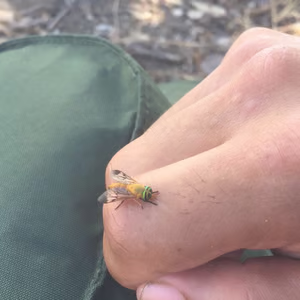
The yellow fly (Diachlorus ferrugatus) is one of the most notorious biting flies found in the southeastern United States, particularly in coastal and wetland regions where warm temperatures and abundant moisture create ideal breeding conditions. Despite its common name, the insect is not entirely yellow. Adults typically have a golden-yellow to orange-brown body, vivid iridescent green or blue-green eyes, and clear wings with dark markings that help

distinguish them from other horse flies. The species belongs to the family Tabanidae, a group that includes horse flies and deer flies, all of which are known for the painful bites inflicted by the females. The yellow fly has earned a fearsome reputation among people who live in or visit marshes, forests, beaches, and rural areas of states such as

Florida, Georgia, Alabama, Mississippi, Louisiana, and parts of the Carolinas. Like other tabanid flies, only the female yellow fly feeds on blood. She requires the protein obtained from blood meals to develop her eggs, while males survive

entirely on nectar and other plant sugars. The female uses sharp, blade-like mouthparts to slice through the skin rather than piercing it like a mosquito. She then laps up the blood that pools in the wound. Because this feeding method creates an open cut, the bite is often immediately

painful and may continue to bleed after the fly departs. Saliva injected during feeding contains compounds that prevent blood clotting, contributing to irritation, swelling, itching, and redness. Some individuals experience only mild discomfort, while others develop large, persistent welts or allergic reactions that can last for several days. The life cycle of Diachlorus ferrugatus is closely tied to moist environments.

Females deposit their eggs on vegetation that overhangs wetlands, ponds, marshes, swamps, or other areas with saturated soil. After hatching, the larvae fall into the damp substrate, where they spend many months feeding on small invertebrates and organic material. The larvae are predatory and play a role in the complex food web of wetland ecosystems.

Development is relatively slow, often requiring nearly a year before pupation occurs. Adults emerge primarily during the warmer months, with populations peaking in late spring and summer, although the exact timing varies depending on local climate and weather conditions. Yellow flies are active during daylight hours and rely heavily on their excellent vision to locate hosts. They are attracted by movement, dark colors, body heat,

and carbon dioxide exhaled by humans and animals. Unlike mosquitoes, which often become most active at dawn and dusk, yellow flies commonly attack throughout the day, especially during sunny, humid conditions. They are persistent fliers capable of following a potential host over considerable distances.

Many victims report that the insects circle repeatedly before landing, making them difficult to swat. The flies often target the head, neck, shoulders, and upper body, approaching from behind where they are less likely to be noticed. Although yellow flies are aggressive biters, they are not generally regarded as important vectors of human diseases in North America. Their bites are primarily considered a nuisance because of the pain and local reactions they produce.

However, the open wounds can become infected if scratched excessively, and livestock may suffer reduced feeding and increased stress when repeatedly attacked. Horses, cattle, deer, dogs, and other mammals are frequent targets, and large numbers of biting flies can significantly affect animal behavior and productivity. Controlling yellow fly populations is challenging because the immature stages develop over large natural
wetland areas where pesticide treatments would be environmentally damaging and generally ineffective. Adult flies are also highly mobile, allowing them to disperse from breeding sites into nearby residential or recreational areas. Personal protection therefore remains the most practical approach. Wearing light-colored clothing, avoiding heavily wooded or

marshy areas during peak activity, using insect repellents where appropriate, and remaining inside screened structures during periods of heavy fly activity can reduce the likelihood of being bitten. Specialized sticky traps that exploit the flies’ attraction to dark moving objects have also been used with some success around homes, parks, and recreational areas. Despite their unpleasant interactions with people, yellow flies are native insects that form part of healthy wetland ecosystems. Their larvae serve as predators of smaller invertebrates, while the adults provide food for birds, dragonflies, spiders, and other insect-eating animals.

Male yellow flies, which feed on nectar, may also contribute to pollination of certain flowering plants. As with many insects that are troublesome to humans, Diachlorus ferrugatus illustrates the balance between ecological importance and human inconvenience. While its painful bite has made it one of the least welcome insects in the southeastern United States, it remains an integral component of the diverse habitats in which it evolved.
Further Reading


Sources
- Wikipedia “Diachlorus ferrugatus” https://en.wikipedia.org/wiki/Diachlorus_ferrugatus
- Askifas “Yellow Fly, Diachlorus ferrugatus (Fabricius) (Insecta: Diptera: Tabanidae)” https://ask.ifas.ufl.edu/publication/IN595
- iNaturalist “Yellow Fly of the Dismal Swamp – Diachlorus ferrugatus” https://www.inaturalist.org/taxa/258381-Diachlorus-ferrugatus
- Orkin “Yellow Fly Facts & Information” https://www.orkin.com/pests/flies/yellow-flies
- Florida Pest Control “Deer Fly & Yellow Fly Season in Florida” https://www.flapest.com/deer-and-yellow-flies/
- 30a “Yellow Fly Season Is Here: How to Fight the Bite in South Walton” https://30a.com/yellow-flies/
- South Walton Mosquito District “Oh No! It’s A Yellow Fly!” https://www.southwaltonmosquitocontrol.org/oh-no-it-s-a-yellow-fly
- Bay County Florida “Yellow Fly” https://www.baycountyfl.gov/539/Yellow-Fly
- Insect Identification “Yellow-Fly (Diachlorus ferrugatus)” https://www.insectidentification.org/insect-description.php?identification=Yellow-Fly
- MDedge “Managing Cutaneous Reactions to Yellow Fly (Diachlorus ferrugatus) Bites” https://www.mdedge.com/cutis/article/272412/contact-dermatitis/managing-cutaneous-reactions-yellow-fly-diachlorus-ferrugatus-bites
- Bug Out “Yellow Flies” https://www.bugoutservice.com/pest-info/flies/yellow-flies/
- Amcdsjc “Yellow Flies” https://amcdsjc.org/wp-content/uploads/2020/06/yellow_flies.pdf
