

A child is said to “catch” cooties through close contact with an “infected” person or from an opposite-sex child of a similar age. Of all the germs kids are exposed to on the playground, there’s one they freak out about more than any other: cooties.

The word first appeared during World War I as soldiers’ slang for the painful body lice that infested the trenches. The word is thought to originate from the Austronesian language family, in which the Philippine, Malaysian-Indonesian, and Māori languages have the word kuto or kutu, which in turn refers to a parasitic biting insect.

St. Louis Globe-Democrat – St. Louis, Missouri · Friday, October 13, 1939
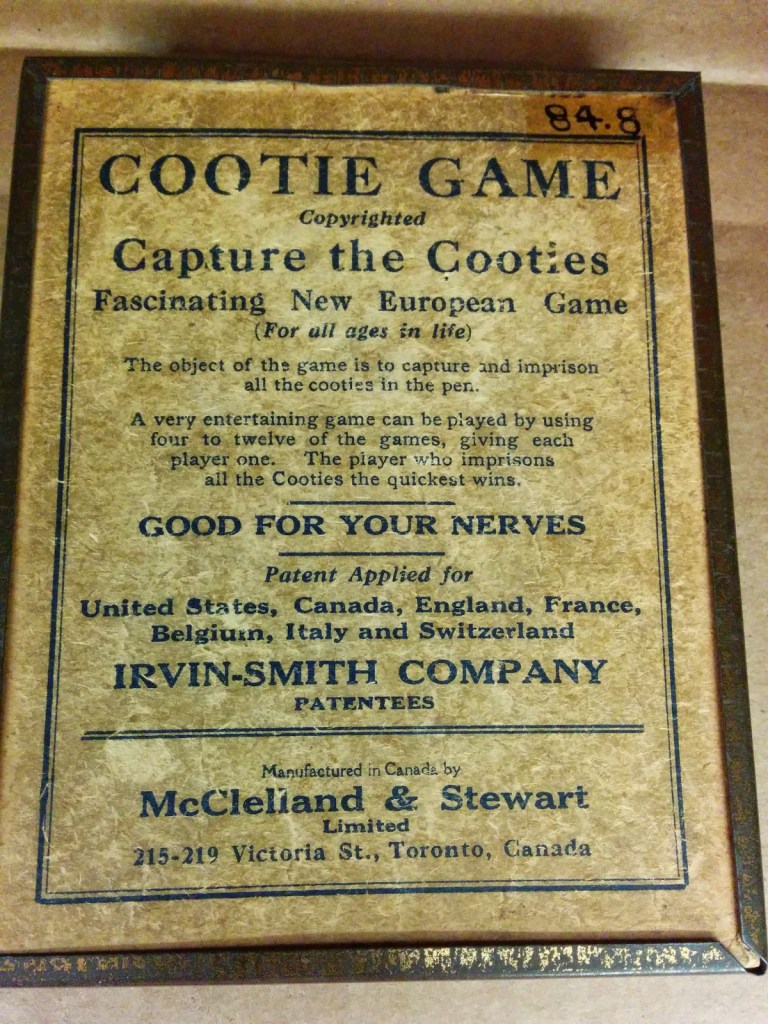
A hand-held game, the Cootie Game, was made by the Irvin-Smith Company of Chicago in 1915; it involved tilting capsules (the cooties) into a trap over a background illustration depicting a battlefield. When the toy was released World War I was already a year old, and the background illustration captures in miniature what troops were experiencing in the Great War: men are poised in trenches;

biplanes fly overhead; cannon fire blasts across the plain; and soldiers with guns and bayonets make their careful way along the game’s bottom edge. It is a cartoon rendition of the horrors of war, cleaned up for childhood entertainment. The Cootie Game was a great seller with patents and distribution in the US, Canada, England, France, Belgium, Italy, and Switzerland. But one has to wonder – what was the response of soldiers when they returned home from the Front and discovered a Catch the Cooties game in their household?

The Game of Cootie is a children’s dice rolling and set collection tabletop game for two to four players. The object is to be the first to build a three-dimensional bug-like object called a “cootie” from a variety of plastic body parts.

Created by William Schaper[1] in 1948 and based on the traditional dice game Beetle, the game was launched in 1949 and was commercially successful, with copies totaling more than one million in the first few years.

In the United States, children sometimes “immunize” one another from cooties by administering a “cootie(s) shot”. Typically, one child administers the “shot”, using an index finger to trace circles and dots on another child’s forearm while reciting the rhyme, “Circle, circle, Dot, dot, – Now you’ve got the cootie shot!”

In some variations, a child then says, “Circle, circle, Square, square, – Now you have it everywhere!” In this case, the child receives an immunization throughout their body. These variations may continue to a final shot where the child says, “Circle, circle, Knife, knife, – Now you’ve got it all your life!”. A number of other variations exist.

The Cootie Catcher is centuries-old origami performed by kids (usually), many of whom live far away from the device’s country of origin. The cootie-catching practice has endured for years. The fortune teller also goes by chatterbox, whirlybird, or salt cellar, and that last name is actually reflective of how the origami figure was first introduced to the United States.

Most sources suggest it’s possible that it appeared in Europe as early as the 17th century. It’s safe to say though that by the 1950s, cootie catchers had started to appear in England and the United States, and propagated from there. Once the cootie catcher is built, you can use it both for grabbing cooties off of your friend (without the worry of infecting yourself), then fill it with messages and use it to tell fortunes.

Cooties is a 2015 American comedy horror film directed by Jonathan Milott and Cary Murnion from a screenplay written by Ian Brennan and Leigh Whannell. The film stars Elijah Wood, Alison Pill, Rainn Wilson, Jack McBrayer, Whannell, Nasim Pedrad, Brennan, and Jorge Garcia as a group of elementary school employees who fight to survive an outbreak among students that turn them into aggressive and cannibalistic zombies when someone eats chicken nuggets containing a virus.
Footnotes
- Schaper Toys, or W.H. Schaper Mfg. Co., Inc. as it was originally known, was a game and toy company founded in 1949 by William Herbert Schaper in Robbinsdale, Minnesota. “Herb” Schaper published a variety of games but was best known for having created the children’s game, Cootie. In 1971, the company was sold to Kusan, Inc., and began operating as Schaper Toys, a subsidiary of Kusan, Inc. In 1986, Schaper Toys was acquired by Tyco Toys, which sold the rights to Cootie and three other of the company’s best-known games to the Milton Bradley Company. These games are still being sold.
Further Reading


Sources
100 Hidden Histories
Wikipedia
Mental Floss
Smithsonian
Scrappleface
