

Johnny Cash’s 1974 spoken-word classic “Ragged Old Flag” stands as one of the most distinctive patriotic recordings in American music, blending storytelling, history, and national reflection into a three-minute recitation that remains closely associated with both the singer and the American flag itself.

Written solely by Johnny Cash and released as the title track and only single from his album of the same name, the song emerged during one of the most turbulent periods in modern American history, as the Vietnam War wound down and the Watergate scandal eroded public confidence in government. Although Cash had once supported President Richard Nixon,

he grew increasingly troubled by the nation’s divisions and sought to create a work that reaffirmed faith not in politicians but in the endurance of the country and its people. Framed as a conversation between a traveler and an elderly man sitting in a courthouse square, the song personifies a worn American flag that has survived wars, attacks, and national struggles, making the “ragged old flag” a symbol of perseverance rather than perfection. Unlike many patriotic songs that celebrate victory or national power,

“Ragged Old Flag” emphasizes resilience, sacrifice, and the idea that America’s strength lies in its ability to endure hardship while continuing to strive toward its ideals. Musically, the piece is unusual within Cash’s catalog because it is primarily spoken rather than sung, accompanied by sparse instrumentation that allows the narrative to take center stage;

among the musicians on the recording was banjo legend Earl Scruggs, while backing vocals were supplied by the Oak Ridge Boys. Released in 1974, the single reached No. 31 on Billboard’s Hot Country Singles chart, while the album peaked at No. 16 on the country album chart, modest commercial results that nevertheless belied the song’s lasting cultural impact. Over the decades, “Ragged Old Flag” has become a staple of Veterans Day observances, Independence Day celebrations, military ceremonies, and patriotic broadcasts,

experiencing renewed popularity after the September 11 attacks and appearing in television coverage surrounding the Super Bowl. Critics have sometimes debated its overt patriotism, with some viewing it as sentimental or jingoistic, while others praise it as a nuanced expression of love for a flawed but enduring nation. Numerous artists and performers have recited or referenced the piece, though Cash’s original recording remains definitive and unmatched in stature. Today, “Ragged Old Flag” is widely regarded as one of the greatest patriotic recordings ever made,

ranking alongside standards such as “God Bless America” and “The Star-Spangled Banner” in the American cultural imagination, and it endures as a testament to Johnny Cash’s unique ability to address complex social and political themes while speaking to audiences across ideological lines.

Released in 1959, “Back in the U.S.A.” is one of Chuck Berry’s most exuberant celebrations of American life and remains among the defining patriotic rock-and-roll songs of the twentieth century. Written solely by Chuck Berry, the song was inspired by his return to the United States following a tour of Australia, during which he reportedly came to appreciate

familiar aspects of American culture such as drive-ins, jukeboxes, and everyday freedoms. Unlike overtly nationalistic songs that focus on politics or military themes, “Back in the U.S.A.” expresses patriotism through ordinary experiences, portraying America as a place of comfort, opportunity, and cultural vitality.

The lyrics chronicle a traveler’s joy upon returning home, delighting in hamburgers, highways, and rock and roll, thereby turning commonplace features of American life into symbols of national identity. Musically, the track exemplifies Berry’s signature style, driven by his influential guitar riffs, energetic rhythm, and vivid storytelling,

all of which helped establish the blueprint for rock music that would later be adopted by artists ranging from the Beatles to the Rolling Stones. Released as a single by Chess Records, the song reached No. 37 on the Billboard Hot 100 and No. 16 on the R&B chart, becoming a modest hit that far outlived its initial chart performance. Over time, “Back in the U.S.A.” has come to be

regarded as one of Berry’s classic recordings and an important example of early rock’s celebration of American culture. Its influence extended beyond Berry’s own version, with notable covers by Linda Ronstadt in 1978 and the Beatles during their early club years, while countless other artists have performed it in concert as a tribute to Berry’s legacy.

Critics and historians often cite the song as an early rock-and-roll counterpart to patriotic standards, notable for presenting patriotism not through grand rhetoric but through affection for everyday American life and consumer culture in the postwar era. The song has appeared in films, television programs, and compilations celebrating both rock history and Americana, and it consistently ranks among

Berry’s essential recordings in retrospectives of his career. Today, “Back in the U.S.A.” endures as both a landmark of rock history and a spirited expression of mid-century American optimism, capturing the sense that home, freedom, and popular culture were deeply intertwined in the national imagination during the golden age of rock and roll.

Released in 2006 as the third single from Rascal Flatts’ fourth studio album Me and My Gang, “My Wish” became one of the trio’s signature songs and one of the most enduring inspirational ballads of the twenty-first century. Written by Jeffrey Steele and Steve Robson, the song originated from Steele’s heartfelt desire to express the hopes a parent has for a child’s future,

though its universal message quickly broadened its appeal beyond family relationships. Rather than focusing on romance or heartbreak, “My Wish” offers a series of blessings and aspirations, wishing that the listener experiences joy, opportunity, resilience, and fulfillment throughout life.

This broad emotional scope has allowed the song to resonate in countless contexts, including graduations, weddings, farewells, memorials, and charitable events, giving it a rare versatility among country hits. Musically, the recording combines contemporary country instrumentation with polished pop production, featuring Gary LeVox’s expressive lead vocals

supported by Jay DeMarcus and Joe Don Rooney’s harmonies, a formula that helped Rascal Flatts become one of the most commercially successful country groups of their era. Released in August 2006, “My Wish” reached No. 1 on the Billboard Hot Country Songs chart and crossed over to the Billboard Hot 100, reflecting its broad appeal across genres. The song earned widespread critical praise for its sincerity and emotional accessibility,

winning the Academy of Country Music Award for Song of the Year in 2007 and receiving a Grammy Award nomination for Best Country Performance by a Duo or Group with Vocal. Over time, “My Wish” became closely associated with ESPN after being featured in numerous sports montages and human-interest stories, particularly those involving perseverance and the

Make-A-Wish Foundation, further cementing its place in American popular culture. Numerous artists have covered or performed the song, and it has been adapted for special occasions ranging from school ceremonies to military tributes, though Rascal Flatts’ original version remains definitive. While not a patriotic song in the traditional sense, its themes of hope, hard work, and optimism align with ideals often associated with the American experience, helping explain why it is sometimes included on broader Americana or inspirational playlists.

Today, “My Wish” is widely regarded as one of Rascal Flatts’ finest recordings and frequently ranks among the greatest inspirational country songs of its generation, enduring as a timeless expression of love, encouragement, and the aspirations people hold for those they care about most.

Released in June 2011 as the lead single from Toby Keith’s fifteenth studio album Clancy’s Tavern, “Made in America” became one of the singer’s most recognizable later-career hits and an anthem celebrating traditional American values, blue-collar pride, and domestic manufacturing.

The song was written by Bobby Pinson and Scott Reeves rather than Keith himself, though its themes aligned closely with the patriotic persona he had cultivated throughout much of his career. Lyrically, the song centers on an elderly man named “Old Man Wrigley,” whose loyalty to American-made products, military service, family values, and country reflects an idealized vision of American identity rooted in hard work and self-reliance.

The chorus repeatedly emphasizes the phrase “made in America,” extending the concept beyond consumer goods to people, values, and national character, thereby framing patriotism as a lived experience rather than merely a political statement. Musically, the track combines contemporary country production with elements of heartland rock,

featuring an upbeat arrangement that complements its celebratory tone and broad appeal. Upon release, “Made in America” proved commercially successful, reaching No. 1 on Billboard’s Hot Country Songs chart in October 2011 and becoming Keith’s nineteenth and final chart-topping country single, an achievement that underscored his enduring popularity in the genre. The song also crossed over onto the Billboard Hot 100, further demonstrating its appeal
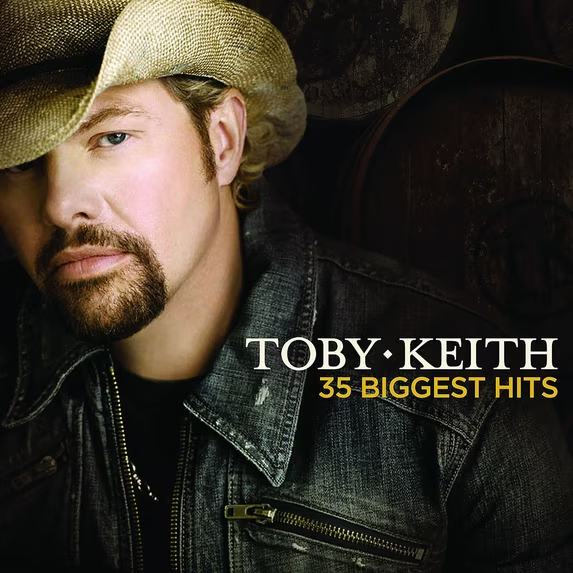
beyond traditional country audiences. Critics generally viewed the song as a more measured and inclusive expression of patriotism than some of Keith’s earlier works, particularly in contrast to the confrontational tone of “Courtesy of the Red, White and Blue (The Angry American),” with many praising its focus on everyday life and generational continuity.

The accompanying music video reinforced these themes through imagery of American workers, military veterans, families, and national landmarks, helping cement the song’s status as a staple of patriotic celebrations, Fourth of July events, and political gatherings.

Although no major alternate studio versions have achieved the prominence of the original recording, Keith performed the song extensively in concert, where it often served as a crowd favorite and an affirmation of the values celebrated in its lyrics. Over time, “Made in America” has become one of the defining patriotic country songs of the twenty-first century, frequently appearing on lists of modern Americana anthems and standing as a testament to Toby Keith’s ability to connect with audiences through songs that celebrate national identity, tradition, and pride in everyday American life.

Released in May 1984 as the lead single from Lee Greenwood’s album You’ve Got a Good Love Comin’, “God Bless the U.S.A.” has become one of the most enduring and recognizable patriotic songs in American history, often regarded as an unofficial national anthem. Written solely by Lee Greenwood, the song was composed during a period when Greenwood wanted

to express his personal gratitude for living in the United States, and he later remarked that he sought to create a song that would resonate with Americans regardless of political affiliation or background. Unlike many patriotic compositions centered on war or military triumph, “God Bless the U.S.A.” focuses on appreciation for freedom, national heritage,

and the sacrifices made by those who defended those ideals, with its famous refrain affirming pride in being an American. Musically, the recording combines traditional country instrumentation with a soaring vocal performance that builds to an emotionally powerful climax, helping make it instantly recognizable across generations. Upon its initial release in 1984,

the song reached No. 7 on Billboard’s Hot Country Singles chart, but its cultural impact far exceeded its original chart performance, experiencing remarkable revivals during periods of national significance. Following the Gulf War in 1991, the song re-entered the country charts, and after the terrorist attacks of September 11, 2001, it returned once again, reaching new audiences and becoming closely associated with national unity and remembrance. In an unprecedented achievement, the song charted during three separate decades,

a testament to its enduring relevance. Over the years, Greenwood has recorded multiple versions of the song, including updated renditions featuring military choirs and collaborative performances with artists such as the U.S. Air Force Band and Home Free, while numerous other performers have covered it in concerts and televised events. The song has become a staple at Fourth of July celebrations, sporting events, military ceremonies, presidential campaigns, and public commemorations,

often serving as an emotional expression of patriotism during times of both celebration and crisis. Critics have occasionally debated its overt nationalism and ubiquity, but even detractors generally acknowledge its profound cultural influence and emotional resonance.

In rankings of patriotic music, “God Bless the U.S.A.” routinely appears alongside “The Star-Spangled Banner,” “America the Beautiful,” and “God Bless America” as one of the defining patriotic songs of the modern era. More than four decades after its release,

the song remains Lee Greenwood’s signature work and stands as one of the most successful and influential patriotic recordings ever produced, embodying themes of gratitude, freedom, resilience, and national pride that continue to resonate with millions of listeners.

Released in March 1980 as a single from Charlie Daniels Band’s album Full Moon, “In America” stands as one of the group’s most direct and exuberant expressions of patriotic pride, blending Southern rock, country, and boogie influences into a high-energy celebration of national resilience. Written by Charlie Daniels, Tom Crain, Jerry Carter,

Fred Edwards, and Charles Hayward, the song emerged during a period of economic uncertainty and geopolitical tension, including the Iran hostage crisis and lingering post-Vietnam disillusionment, and it was conceived as an unapologetic affirmation of American unity in the face of internal and external challenges.

Lyrically, the song contrasts images of global unrest with a defiant chorus asserting that “we’re gonna put a boot in your ass, it’s the American way,” a line that became both its most famous and most controversial element, reflecting the band’s combative style of patriotism rooted in toughness, independence, and cultural pride.

Musically, “In America” features the Charlie Daniels Band’s signature Southern rock instrumentation, driven by fiddle, electric guitar, and a rollicking rhythm section, with Daniels’ distinctive fiddle playing helping distinguish it from other patriotic rock songs of the era. Upon release, the song reached No. 11 on the Billboard Hot Country Singles chart

and crossed into the Billboard Hot 100, marking it as one of the band’s more commercially successful patriotic-themed releases. Over time, it became a staple of concert performances, particularly at Independence Day events, political rallies, and sporting occasions, where its rousing chorus often elicited strong audience participation. Multiple live versions have been recorded,

including performances on albums such as Live! (Charlie’s Classics) and various compilation releases, each reinforcing its reputation as a high-energy crowd anthem rather than a studio-bound single. Critics have historically been divided on the song, with some praising its unapologetic celebration of American identity

and others criticizing its aggressive tone and simplification of geopolitical themes, yet its cultural staying power has remained strong, particularly among fans of Southern rock and country rock traditions. “In America” is frequently ranked among the Charlie Daniels Band’s most iconic recordings, alongside “The Devil Went Down to Georgia,”

and it continues to appear on patriotic playlists and retrospective collections of American rock music. More than four decades after its release, the song endures as a defining statement of late-20th-century populist patriotism, reflecting both pride in American identity and the stylistic boldness of Southern rock in its commercial peak.
- Alabama – American Pride
- Alabama – Song of the South
- The Beach Boys – Surfin’ U.S.A.
- Berlin, Irving – God Bless America
- Berry, Chuck – Back in the U.S.A.
- Brown, James – Living in America
- Cash, Johnny – Ragged Old Flag
- Charles, Ray – America the Beautiful
- Cohan, George M. – Over There
- Cohan, George M. – You’re a Grand Old Flag
- Creedence Clearwater Revival – Fortunate Son
- Daniels Band, Charlie – In America
- Denver, John – Take Me Home, Country Roads
- Diamond, Neil – America
- Greenwood, Lee – God Bless the U.S.A.
- Guthrie, Woody – This Land Is Your Land
- Haggard, Merle – The Fightin’ Side of Me
- Haggard, Merle – Okie from Muskogee
- Hendrix, Jimi – The Star-Spangled Banner
- Horton, Johnny – The Battle of New Orleans
- Houston, Whitney – The Star-Spangled Banner
- Jennings, Waylon – America
- Keith, Toby – American Soldier
- Keith, Toby – Courtesy of the Red, White and Blue (The Angry American)
- Keith, Toby – Made in America
- Kravitz, Lenny – American Woman
- Lynyrd Skynyrd – Red White & Blue
- Mellencamp, John – R.O.C.K. in the U.S.A.
- McBride, Martina – Independence Day
- McLean, Don – American Pie
- Paisley, Brad – American Saturday Night
- Parton, Dolly – Color Me America
- Presley, Elvis – An American Trilogy
- Rascal Flatts – My Wish
- Robbins, Marty – The Ballad of the Alamo
- Sadler, Barry – The Ballad of the Green Berets
- Simon & Garfunkel – America
- Sousa, John Philip – The Stars and Stripes Forever
- Springsteen, Bruce – Born in the U.S.A.
- Springsteen, Bruce – American Land
- The Statler Brothers – More Than a Name on a Wall
- The Statler Brothers – Whatever Happened to Randolph Scott
- Tippin, Aaron – Where the Stars and Stripes and the Eagle Fly
- Travis, Randy – America Will Always Stand
- Worley, Darryl – Have You Forgotten?
- Worley, Darryl – Have We Forgotten?
Videos
Further Reading


Sources
- Wikipedia “Ragged Old Flag (song)” https://en.wikipedia.org/wiki/Ragged_Old_Flag_%28song%29
- Wikipedia “Back in the U.S.A.” https://en.wikipedia.org/wiki/Back_in_the_U.S.A.
- Wikipedia “My Wish” https://en.wikipedia.org/wiki/My_Wish
- Wikipedia “Made in America (Toby Keith song)” https://en.wikipedia.org/wiki/Made_in_America_(Toby_Keith_song)
- Wikipedia “God Bless the U.S.A.” https://en.wikipedia.org/wiki/God_Bless_the_U.S.A.
- Wikipedia “In America (song)” https://en.wikipedia.org/wiki/In_America_(song)
- 45 Cat https://www.45cat.com/
