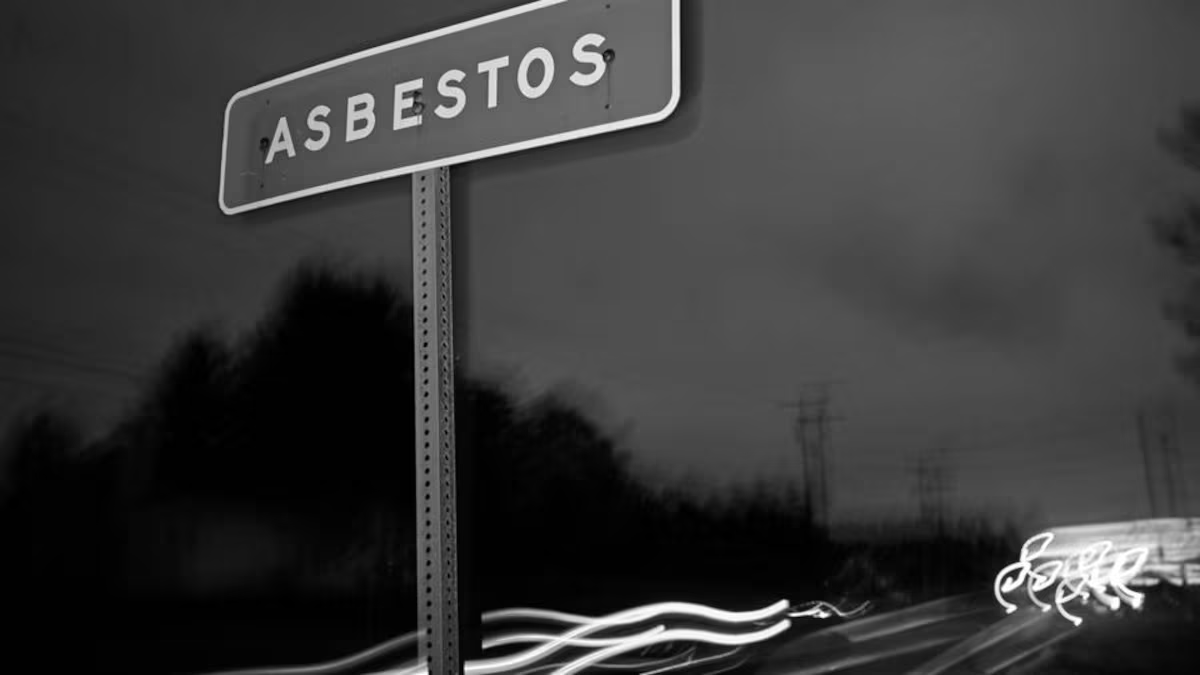

The town now known as Val-des-Sources, located in Quebec’s Eastern Townships, is one of the most unusual communities in Canadian history because it was built almost entirely around one mineral: asbestos. For well over a century the community was internationally famous under its former name, Asbestos, Quebec, a name that was synonymous with one of the world’s richest chrysotile asbestos deposits.

The discovery of vast asbestos deposits in the late nineteenth century transformed what had been a quiet rural area into a booming mining center whose products were exported around the globe. At its peak, the town represented economic prosperity, industrial progress, and Canadian mining expertise. Decades later, however, mounting scientific evidence

linking asbestos exposure to deadly diseases caused demand to collapse, mines to close, and the town to confront an identity crisis unlike almost any other community in North America. The eventual decision to abandon the name “Asbestos” and adopt “Val-des-Sources” symbolized not only a break with a controversial past but also an

attempt to build a more diversified future. The area’s modern history began in the 1870s when extensive chrysotile asbestos deposits were identified beneath the hills surrounding the community. Mining expanded rapidly after entrepreneurs recognized the mineral’s commercial potential. Asbestos fibers were prized because they

were flexible, resistant to heat, resistant to chemical damage, and capable of being woven into fabrics or incorporated into cement, insulation, roofing materials, brake linings, gaskets, and countless industrial products. The Jeffrey Mine, eventually one of the largest open-pit asbestos mines in the world, became the economic engine of the town. It attracted workers from throughout Quebec

and beyond, creating jobs not only in mining but also in transportation, manufacturing, engineering, and retail businesses. By the early twentieth century, the town had become one of the world’s leading producers of chrysotile asbestos, and the name “Asbestos” was recognized internationally wherever industrial materials were bought and sold. The prosperity generated by the mines reshaped nearly every aspect of community life.

Homes, schools, churches, hospitals, businesses, and recreational facilities were built to serve a growing population. Mining companies invested heavily in local infrastructure, while generations of families found stable employment underground or in processing plants. During much of the twentieth century,

asbestos was often described as a “miracle mineral” because of its extraordinary fire-resistant qualities. Its use expanded dramatically during both World Wars and throughout the postwar construction boom. At the height of production, the Jeffrey Mine’s enormous open pit became one of the defining landmarks of Quebec’s mining industry, and the town itself became a symbol of Canada’s natural resource wealth. Yet even while the industry flourished,

concerns about worker health gradually emerged. Medical researchers had begun documenting serious lung diseases among asbestos workers as early as the first half of the twentieth century. Continued research eventually established that inhaled asbestos fibers could cause asbestosis, lung cancer,

mesothelioma, and other life-threatening illnesses. Although chrysotile producers argued that their form of asbestos could be used safely under controlled conditions, public health agencies increasingly concluded that no level of exposure could be considered entirely risk-free.

Throughout the latter decades of the twentieth century, governments around the world imposed increasingly strict regulations or outright bans on asbestos products. Construction companies, manufacturers, and consumers steadily abandoned the material in favor of safer alternatives. The town’s fortunes declined alongside the global asbestos market. Employment fell sharply as international

demand weakened and export markets disappeared. Political debates became increasingly contentious because many residents depended on mining for their livelihoods, while health experts and labor organizations warned of the severe medical consequences associated with asbestos exposure.

The Jeffrey Mine struggled financially despite repeated efforts to modernize operations and secure new investment. Canadian governments faced growing criticism for continuing to support asbestos exports even as domestic use declined dramatically. In 2012, after numerous unsuccessful attempts to revive commercial production, the Jeffrey Mine effectively ceased operations, marking the end of an era that had defined the community for more than 130 years.

The collapse of the asbestos industry left the town with difficult economic and emotional challenges. Businesses closed, younger residents moved elsewhere in search of work, and municipal leaders sought new industries capable of replacing mining. At the same time, the town faced an unusual branding problem.

While the name “Asbestos” had once been a source of civic pride, it had become closely associated worldwide with disease, environmental contamination, litigation, and industrial tragedy. Businesses reported difficulties attracting investors, tourists, and new residents because the town’s very name evoked negative reactions. Internet searches, international trade, and corporate marketing all

reinforced the association between the community and the hazardous mineral rather than its natural beauty or economic opportunities. After years of discussion, local officials proposed changing the town’s name to better reflect its aspirations for the future. In October 2020, residents voted in favor of renaming the municipality Val-des-Sources,

meaning “Valley of the Springs” or “Valley of the Sources.” The new name officially took effect in December 2020. Municipal leaders explained that the change was intended to improve economic development, attract new investment, encourage tourism, and help the community move beyond the legacy of asbestos mining. Although some longtime residents regretted losing a name that had represented generations of family history and hard work,

others viewed the change as a necessary step toward redefining the town for future generations. Today, Val-des-Sources continues the difficult process of economic transition. While its mining heritage remains an important part of local history, the community has focused on diversification through manufacturing, technology, environmental redevelopment, recreation, and tourism.

The immense Jeffrey Mine remains a dramatic physical reminder of the town’s origins, while museums and historical exhibits preserve the story of the miners and families who built the community. The town’s history illustrates both the remarkable economic opportunities created by natural resources and the profound consequences that can arise

when scientific understanding changes society’s perception of a once-celebrated industrial material. Few places in the world better demonstrate how a community’s identity can be shaped, challenged, and ultimately reinvented in response to changing knowledge, public health priorities, and global economic forces.
Further Reading


Sources
- NiCHE “The Town (Once) Called Asbestos” https://niche-canada.org/2020/10/29/the-town-once-called-asbestos/
- BBC “New name for a Canadian town called Asbestos” https://www.bbc.com/news/world-us-canada-54608836
- Global News “Asbestos, Quebec town once home to Canada’s largest asbestos mine, gets a new name” https://globalnews.ca/news/7405121/asbestos-town-name-change-vote/
- Asbestos “Asbestos Mining Town in Canada Searches for New Identity” https://www.asbestos.com/news/2016/11/07/asbestos-mining-town-canada-new-identity/
- Atlas Obscura “Asbestos Mine” https://www.atlasobscura.com/places/asbestos-mine
- Wikipedia “Val-des-Sources” https://en.wikipedia.org/wiki/Val-des-Sources
- ETRC “Asbestos: How Lethal Minerals Built a Town” https://www.etrc.ca/asbestos-how-lethal-minerals-built-a-town/
