

The Yardbirds emerged from the vibrant rhythm and blues scene that flourished in London during the early 1960s, becoming one of the most influential British bands of the decade. Although they would later gain worldwide recognition for helping launch the careers of three legendary guitarists—Eric Clapton, Jeff Beck, and Jimmy Page—

their earliest history was rooted in a shared enthusiasm for American blues, jazz, and rock and roll. Before they became pioneers of psychedelic rock and experimental guitar techniques, they were a hardworking club band dedicated to faithfully reproducing the music of artists such as Muddy Waters, Howlin’ Wolf, Bo Diddley, Chuck Berry, Jimmy Reed, and Sonny Boy Williamson II.

Their reputation was built not on commercial success but on energetic live performances, extended improvisations, and a willingness to stretch traditional blues into something more adventurous. The origins of the group can be traced to southwest London in 1963. Guitarist Anthony “Top” Topham, rhythm guitarist Chris Dreja, bassist Paul Samwell-Smith,

drummer Jim McCarty, and vocalist Keith Relf were all part of the local music scene and had performed in various amateur bands before joining forces. The group initially performed under several names before settling on “The Yardbirds,” reportedly inspired by the writings of author Jack Kerouac, who used the slang term “yardbird” to describe a drifter or someone living on the margins of society.

Another possible influence was the jazz nickname “yardbird” associated with saxophonist Charlie Parker. Whatever the exact origin, the unusual name quickly distinguished the band from many of their contemporaries. Keith Relf became the band’s charismatic frontman. Born in Richmond, Surrey, he had a strong interest in blues and folk music and possessed a distinctive voice

capable of both gritty blues interpretations and melodic rock singing. Chris Dreja initially played rhythm guitar and contributed to the band’s visual identity through his photography, while Paul Samwell-Smith, an accomplished bassist with a deep appreciation for American blues, often served as one of the group’s musical organizers. Jim McCarty provided a solid yet inventive drumming style that balanced technical precision with an instinctive feel for blues rhythms.
Studio Album Band Members

Keith Relf was the Yardbirds’ original lead vocalist, harmonica player, and an occasional guitarist. Appearing on every studio album released during the band’s original run, he was the only constant lead singer throughout the 1960s and became one of the defining voices of the British blues boom. His soulful vocals and blues harmonica remained

central to the band’s identity even as its music evolved from rhythm and blues into psychedelic and experimental rock. Following the Yardbirds, he co-founded Renaissance and later Armageddon before his accidental death in 1976.

Chris Dreja was a founding member who began as the Yardbirds’ rhythm guitarist before switching to bass in 1966 after Paul Samwell-Smith left the band. He appeared on every original Yardbirds studio album and returned for the reunion album Birdland in 2003. Although often overshadowed by the

band’s celebrated lead guitarists, Dreja’s steady playing and songwriting contributions were essential to the group’s success. He later became a respected professional photographer before returning to music for the reunion, and he died on Thursday, September 25, 2025, at the age of 79.

Paul Samwell-Smith was the original bassist and one of the Yardbirds’ most important musical architects. In addition to his bass playing, he contributed arrangements, songwriting, and production ideas, even co-producing Roger the Engineer. After leaving the band in 1966, he embarked on a highly successful career as a record producer,

working with artists such as Cat Stevens, Carly Simon, Renaissance, and Jethro Tull, earning a reputation as one of Britain’s finest producers.

Jim McCarty is the only founding member still actively associated with the Yardbirds. As drummer, percussionist, vocalist, and songwriter, he appeared on all four original studio albums and later on Birdland.

His inventive drumming helped define the band’s famous “rave-up” style, and since helping revive the Yardbirds in the early 1990s, he has remained the group’s leader and guardian of its musical legacy.

Eric Clapton joined the Yardbirds in late 1963 after Top Topham’s departure and appeared on much of For Your Love and portions of Having a Rave Up. His dedication to authentic Chicago blues established the band’s early reputation among musicians,

but he chose to leave in 1965 when the group began moving toward a more commercial sound. Clapton went on to become one of rock’s most celebrated guitarists through his work with John Mayall’s Bluesbreakers, Cream, Blind Faith, Derek and the Dominos, and his long-running solo career.

Jeff Beck replaced Clapton in 1965 and appeared on For Your Love, Having a Rave Up, and Roger the Engineer. His revolutionary use of distortion, feedback, sustain, and other innovative guitar techniques transformed the Yardbirds into one of the most forward-thinking rock bands of the 1960s. Beck later enjoyed an acclaimed solo career,

won multiple Grammy Awards, and became widely regarded as one of the greatest electric guitarists of all time before his death on Tuesday, January 10, 2023.

Jimmy Page joined the Yardbirds in 1966, initially playing bass before moving to lead guitar. Although he briefly shared lead guitar duties with Jeff Beck, his only complete original studio album with the band was Little Games. After the Yardbirds disbanded in 1968, Page fulfilled the group’s remaining concert

commitments with a new lineup called the New Yardbirds, which soon became Led Zeppelin, one of the most influential and successful rock bands in history.

John Idan joined the reunited Yardbirds in 1992 as lead vocalist and bassist and performed on the reunion studio album Birdland. His blues-based singing and solid bass playing helped reconnect the band with its original

musical roots while introducing new material alongside updated versions of classic Yardbirds songs. He became the longest-serving lead vocalist of the reunion era and returned for a second tenure with the band beginning in 2015.
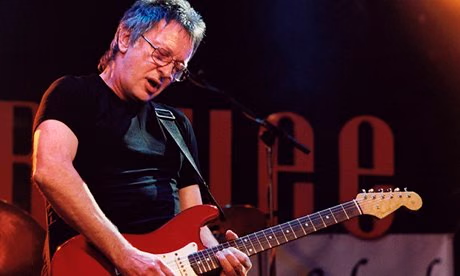
Gypie Mayo joined the reunited Yardbirds in 1996 as lead guitarist after establishing himself with Dr. Feelgood. On Birdland, he provided powerful blues-rock guitar work while sharing the spotlight with a

number of distinguished guest guitarists. Mayo remained with the band until 2004 and continued performing with other artists before his death from cancer in 2013.

Alan Glen joined the reunited Yardbirds in 1996 as harmonica player and backing vocalist. His authentic blues harmonica playing on Birdland helped restore one of the band’s defining musical

elements, echoing the style that Keith Relf had established during the original group’s heyday. Glen remained an important part of the reunion lineup through much of the 2000s and was well respected within the British blues community.

Completing the original lineup was Anthony “Top” Topham, a talented teenage lead guitarist whose clean, blues-oriented playing helped establish the band’s earliest musical direction. The Yardbirds quickly became regular performers at London’s Crawdaddy Club in Richmond after succeeding the Rolling Stones as the venue’s house band.

This proved to be a pivotal opportunity. The Crawdaddy had become one of the focal points of Britain’s growing rhythm and blues movement, attracting audiences eager to hear authentic American blues performed by young British musicians. The Yardbirds’ live shows soon developed a devoted following. They became known for what fans and musicians alike referred to as their “rave-ups,”

extended instrumental passages in which a song would gradually increase in tempo and intensity before reaching a dramatic climax. These improvisational sections became one of the band’s trademarks and later influenced numerous rock groups throughout the 1960s. Despite the promise shown by the original lineup, Anthony Topham left the band after only a few months.

His parents encouraged him to focus on his education rather than pursue an uncertain musical career, and he departed before the group achieved national recognition. His replacement was Eric Clapton, then an eighteen-year-old guitarist who had already earned a reputation among London’s blues enthusiasts. Clapton’s arrival strengthened the band’s commitment to authentic

Chicago blues and greatly enhanced its musical credibility. His precise phrasing, expressive bends, and deep knowledge of blues traditions quickly made him one of Britain’s most respected young guitarists. Manager Giorgio Gomelsky played a crucial role in the Yardbirds’ early development. A colorful entrepreneur with a keen ear for talent,

Gomelsky had been instrumental in promoting the Crawdaddy Club and recognized the Yardbirds’ potential almost immediately. He secured performances, guided their early career, and encouraged the band to record live whenever possible, believing that their greatest strength lay in the excitement and spontaneity of their stage

performances rather than carefully constructed studio recordings. His enthusiasm helped establish the Yardbirds as one of London’s premier rhythm and blues attractions before they had even achieved chart success. One of the band’s earliest significant recordings came when they backed legendary American blues harmonica player Sonny Boy Williamson II during his British tour.

The resulting live album, Sonny Boy Williamson and the Yardbirds, captured the group accompanying one of their musical heroes and provided valuable recording experience. Although the album was not a major commercial success, it demonstrated the respect the young British musicians had for authentic American blues and highlighted their growing confidence as performers.

Williamson reportedly enjoyed working with the group despite occasional misunderstandings arising from differences in musical style and touring expectations. The Yardbirds’ breakthrough among British audiences came with the live album Five Live Yardbirds, recorded at the Marquee Club in London and released in late 1964. Rather than emphasizing polished studio production,

the album showcased the band’s explosive stage act, featuring extended versions of rhythm and blues standards by artists such as Bo Diddley, Smokey Robinson, John Lee Hooker, and others. The record captured the excitement of their famous rave-ups and revealed the chemistry between Relf’s energetic vocals, Clapton’s fiery lead guitar, Samwell-Smith’s inventive bass lines,

Dreja’s steady rhythm guitar, and McCarty’s dynamic drumming. Although it did not become an immediate bestseller, Five Live Yardbirds has since come to be regarded as one of the finest live British rhythm and blues albums of the era. By the beginning of 1965, the Yardbirds had firmly established themselves as one of Britain’s leading rhythm and blues groups. Their popularity was steadily increasing through relentless touring, television appearances, and growing recognition among fellow musicians.

Yet they also faced an important crossroads. Managerial pressure and changing musical tastes were encouraging British groups to pursue original material and more commercially appealing songs, while several members—particularly Eric Clapton—remained deeply committed to traditional electric blues. Those competing artistic ambitions would soon reshape the band’s future, setting the stage for one of the most significant turning points in British rock history.

However, up to this point, before the release of For Your Love, the Yardbirds had earned their reputation primarily through their dedication to American blues, their electrifying live performances, and the remarkable chemistry of a lineup that laid the foundation for one of rock music’s most influential careers.
For Your Love

For Your Love was the first American studio album by the Yardbirds and was released by Epic Records in June 1965, although it was never issued in the United Kingdom in its original form. Rather than being conceived as a unified studio project, the album was assembled by manager and producer Giorgio Gomelsky to

capitalize on the enormous success of the hit single “For Your Love” as the band prepared for its first American tour. As a result, it combines previously released singles, B-sides, unreleased recordings, and recent studio sessions spanning more than a year. This unique approach also makes it an important historical document,

as it is the only Yardbirds studio album to feature recordings by both Eric Clapton and his successor Jeff Beck. Clapton performs on most of the album, while Beck makes his recording debut with the band on “I’m Not Talking,” “I Ain’t Done Wrong,” and the extended version of “My Girl Sloopy.”

The transition between two of rock’s greatest guitarists gives the album a special place in the Yardbirds’ catalog and foreshadows the remarkable musical evolution that would soon follow. Although assembled primarily for the American market, the album became the Yardbirds’ first charting LP in the United States, reaching No. 96 on the Billboard Top LPs chart.

The songs were written by a variety of composers, reflecting the band’s transition from performing American rhythm-and-blues standards to recording original material. Graham Gouldman, who would later co-found 10cc, wrote the title track “For Your Love,” while other songs were written by Bo Diddley, Billy Boy Arnold, Mose Allison, Don Covay, Elmore James,

Chuck Willis, and other American blues and R&B writers. Original Yardbirds compositions included Keith Relf’s “I Ain’t Done Wrong,” although it was heavily inspired by Eddie Kirkland’s “I Must Have Done Somebody Wrong,” as well as instrumental contributions from the band. Musically, the album captures the Yardbirds at a crossroads.

Earlier tracks emphasize authentic Chicago blues, featuring Clapton’s restrained but expressive guitar work, while Beck’s recordings introduce a far more aggressive, experimental style marked by heavier tone, feedback, and greater use of sustain. The title song itself represented a dramatic departure from the group’s blues roots,

incorporating harpsichord, bongos, bowed bass, and an unusually sophisticated pop arrangement that helped establish the emerging baroque pop style. Brian Auger performed the distinctive harpsichord part, while session musicians contributed the bowed bass and percussion that gave the recording its memorable sound.

Although the song became the Yardbirds’ first international hit, reaching the Top 10 in both the United Kingdom and the United States, it also prompted Eric Clapton to leave the band because he believed its commercial direction compromised the group’s commitment to authentic blues.

His departure opened the door for Jeff Beck, whose arrival fundamentally changed the band’s musical identity. The album cover has become something of a curiosity among collectors because it prominently features Jeff Beck seated at a keyboard, even though he does not play keyboards anywhere on the album and appears on only three tracks.

Eric Clapton, who actually performed on most of the recordings, is absent from both the cover photograph and the liner notes because he had already left the group by the time the album was assembled. The cover therefore unintentionally symbolizes the changing of the guard within the Yardbirds, emphasizing the band’s future rather than its past. Critical opinion of For Your Love has evolved considerably over the decades.

At the time of its release, some reviewers noted its uneven nature because of its compilation-like assembly, but later critics have recognized it as an invaluable snapshot of one of Britain’s most influential bands during a period of rapid transformation. Modern reviewers frequently praise the contrast between Clapton’s traditional blues approach and Beck’s adventurous guitar style,

making the album one of the few opportunities to compare the two guitarists in nearly the same musical setting. While Roger the Engineer is generally regarded as the Yardbirds’ artistic masterpiece, For Your Love remains one of their most historically significant releases because it documents the exact moment the band shifted from being a respected British blues group into one of rock’s great innovators. Numerous reissues have appeared over the years from labels including Repertoire, Castle, JVC, Charly, and others,

often expanding the original eleven-track album with bonus singles, alternate takes, demos, and previously unreleased material. Today, the album is valued not only for its hit title track but also for preserving the earliest recorded work of Jeff Beck with the Yardbirds, the final commercially released recordings of Eric Clapton with the group, and the musical bridge between the British blues boom and the experimental rock revolution that would soon follow.
Heart Full of Soul

Heart Full of Soul is a somewhat unusual entry in the Yardbirds’ discography because it was not an official studio album released by the band in either the United Kingdom or the United States during its active years, but rather the title used for the Canadian debut LP issued by Capitol Records in 1965,

where it was also marketed as Presenting the Yardbirds. The album was assembled to introduce the rapidly rising British group to Canadian audiences following the success of the hit singles “For Your Love” and “Heart Full of Soul.” Like several early Yardbirds albums, it was not conceived as a unified artistic statement but instead

compiled previously released singles, B-sides, and blues-oriented recordings from different sessions. The result nevertheless provides an excellent snapshot of the band’s evolution during one of the most exciting periods in its history, capturing the transition from the Eric Clapton era into the arrival of Jeff Beck, whose innovative guitar style would soon transform the group’s sound.

The collection includes songs written by an impressive variety of composers. Graham Gouldman, years before becoming a founding member of 10cc, contributed both “For Your Love” and the title track “Heart Full of Soul,” two of the Yardbirds’ biggest international hits. Other material came from American blues and rhythm-and-blues writers including Bo Diddley, Chuck Berry, Billy Boy Arnold, Don Covay, Elmore James, and others,

while the band also began contributing original compositions such as Keith Relf’s “I Ain’t Done Wrong.” The title song “Heart Full of Soul” remains one of the Yardbirds’ defining recordings. Written by Graham Gouldman, it explores the emotional pain of unrequited love and longing, with Keith Relf’s melancholy vocal expressing

deep heartbreak while Jeff Beck’s distinctive guitar imitates the sound of an Indian sitar. Producer Giorgio Gomelsky originally attempted to record the song using an actual sitar player, but the results proved unsatisfactory because the instrument did not blend effectively with the band’s rock arrangement. Beck then devised one of rock’s earliest and most convincing “raga rock” guitar sounds by using careful string bends, vibrato, and tone control to

recreate the sitar’s distinctive character, making the recording one of the earliest successful fusions of Indian musical influences and rock several months before similar experiments by the Beatles and the Rolling Stones became widely known. The album therefore documents one of the earliest milestones in psychedelic and raga-influenced rock music.

Although Eric Clapton appears on much of the material included on the LP, Jeff Beck is featured on the title track and several later recordings, making the album historically significant as a bridge between two of the greatest guitarists in rock history. The Canadian cover art differs substantially from the American For Your Love album

and other international releases, featuring a straightforward promotional photograph of the band designed to capitalize on their growing popularity. Like many mid-1960s Capitol Canada releases, the artwork emphasized the group’s youthful image rather than attempting elaborate graphic design.

Because several different pressings and reissues have appeared over the decades, collectors encounter variations in cover color, labels, and track sequencing, adding to the album’s appeal among Yardbirds enthusiasts. Although Heart Full of Soul itself has never been ranked alongside the Yardbirds’ acknowledged masterpiece Roger the Engineer,

it occupies an important place in the band’s recording history because it introduced Canadian audiences to both their blues roots and their increasingly adventurous musical direction. Critics and historians generally view it as a valuable regional release that captures the Yardbirds during one of the most important transitional periods in British rock, as Eric Clapton departed and Jeff Beck began pushing the group

toward the innovative guitar techniques, feedback, distortion, and Eastern musical influences that would become trademarks of the band’s later work. Several of its tracks have since appeared on major anthologies and greatest-hits collections, including The Yardbirds Greatest Hits, Ultimate!, Train Kept A-Rollin’: The Complete Giorgio Gomelsky Productions, Glimpses 1963–1968, and numerous deluxe reissues,

ensuring that the material remains readily available even though the original Canadian LP has become a desirable collector’s item. Today, Heart Full of Soul is remembered less as a distinct artistic album than as an important historical compilation documenting one of rock’s most influential bands at the precise moment they were helping redefine the possibilities of electric guitar and laying the groundwork for the psychedelic and hard rock movements that would soon follow.
Yardbirds a.k.a. Roger the Engineer (Over Under Sideways Down)

Roger the Engineer, the third studio album by the Yardbirds, is one of the most historically important and influential albums of the 1960s, capturing the band at the height of its creativity and documenting the moment when British rhythm and blues evolved into psychedelic rock and the heavier guitar-based music that would follow.

Released in the United Kingdom on July 15, 1966, by Columbia Records, the album was officially titled Yardbirds, but it became widely known as Roger the Engineer because of the unusual cartoon artwork on the original British cover. In the United States, Epic Records released the album on July 18, 1966, under the title Over Under Sideways Down,

named after the Yardbirds’ successful single that became the centerpiece of the American version. The multiple titles, different covers, and altered track listings have made the album one of the most interesting and collectible releases in the Yardbirds catalog. More importantly, it represents the creative peak of the classic Jeff Beck lineup,

featuring Keith Relf on lead vocals and harmonica, Jeff Beck on lead guitar, Chris Dreja on rhythm guitar, Paul Samwell-Smith on bass, and Jim McCarty on drums. It was the only Yardbirds studio album where Jeff Beck appears on every track, making it the definitive recording of his time with the group and one of the earliest examples of a rock guitarist using the electric guitar as an experimental

instrument capable of creating new sounds, textures, and atmospheres rather than simply playing traditional solos. Unlike the band’s earlier albums, which were often collections of singles, B-sides, and blues covers assembled differently for various markets, Yardbirds was a true album project, consisting almost entirely of original material written by members of the band.

The songwriting credits were shared primarily among Keith Relf, Jim McCarty, Jeff Beck, Chris Dreja, and Paul Samwell-Smith, representing a major artistic step forward because the Yardbirds were no longer simply interpreting American blues songs but were creating their own musical identity. The album opens with “Lost Women,” a powerful blues-rock track that immediately establishes the heavier and more experimental direction the band was taking,

featuring Beck’s aggressive tone and the band’s famous rave-up style. The best-known song from the album, “Over Under Sideways Down,” was written collectively by all five members of the group and became one of the Yardbirds’ signature recordings. Its strange title, surreal lyrics, and unconventional arrangement reflected the influence of the

psychedelic movement that was beginning to transform popular music in the mid-1960s. Jeff Beck’s guitar work on the song was groundbreaking, using fuzz, distortion, unusual phrasing, and Eastern-inspired melodic ideas to create a sound unlike anything most listeners had heard before. The song became a major hit, reaching the Top 10

in the United Kingdom and becoming one of the band’s most recognizable recordings in America. The rest of the album continued to explore new musical territory, with “The Nazz Are Blue” featuring Jeff Beck singing lead vocals as well as playing guitar, making it one of the rare Yardbirds recordings where the guitarist took center stage as a vocalist. “Rack My Mind”

combined traditional blues structures with a much heavier guitar attack, while “Hot House of Omagararshid” experimented with unusual rhythms and exotic musical influences. “Turn Into Earth” created a mysterious and atmospheric mood with its haunting arrangement, while “Ever Since the World Began”

and “He’s Always There” showed the band’s ability to create more reflective and melodic songs. Together, these tracks demonstrated that the Yardbirds were moving far beyond their early blues roots and becoming one of the most adventurous rock groups of their era. The album’s famous cover art has become almost as legendary as the music itself. Chris Dreja, the band’s rhythm guitarist, created the original British artwork,

which featured a hand-drawn cartoon of recording engineer Roger Cameron wearing headphones and surrounded by recording equipment. The words “Roger the Engineer” appeared as part of the drawing, and although that was not the official title of the album, the nickname became so popular that many fans and later reissues adopted it.

The cover was unusual for its time because it avoided the typical band photograph approach and instead reflected the Yardbirds’ increasingly creative and unconventional image. The American Over Under Sideways Down edition featured completely different artwork, using a photograph of the group and focusing more on the commercial success of the single rather than the

experimental nature of the album itself. The different international versions also created significant variations in the music. The original British release contained ten tracks, while the American Over Under Sideways Down edition removed “The Nazz Are Blue” and “Rack My Mind” and presented a different running order. Later reissues restored the complete British album and added bonus material from the same period, including alternate takes,

demos, and related singles. The song “Happenings Ten Years Time Ago,” recorded later in 1966 and featuring both Jeff Beck and Jimmy Page on guitar, has frequently been included with expanded editions because it represents the transition period between the Yardbirds’ classic lineup and the band’s final months before becoming the foundation for Led Zeppelin.

Although Yardbirds was not initially a huge commercial success compared with the band’s hit singles, its reputation grew steadily over the decades, and it is now considered one of the essential albums of the British Invasion era. The album reached number 20 on the United Kingdom album chart and number 52 on the American Billboard album chart, but its long-term influence far exceeded its original sales. Critics and historians have praised it for combining blues,

psychedelic experimentation, and revolutionary guitar work, and it has frequently appeared on lists of the greatest and most influential rock albums ever recorded. Many musicians consider Jeff Beck’s playing on the album to be among the most important guitar work of the 1960s because it demonstrated new possibilities for tone, technique, and expression. One of the most important pieces of trivia about the album is that it represents the final major statement from the classic Jeff Beck-era Yardbirds. Shortly after its release, Paul Samwell-Smith left the group,

Jimmy Page joined first as bassist and later as a second guitarist, and Beck eventually departed, leaving Page to guide the remaining members toward the formation of Led Zeppelin. At the same time, Beck would continue his own groundbreaking career, becoming one of the most respected and innovative guitarists in history. Because of these connections, Yardbirds is not only an outstanding album in its own right but also a crucial link between the British blues explosion, psychedelic rock,

and the development of hard rock. Today, whether called Yardbirds, Roger the Engineer, or Over Under Sideways Down, the album remains the definitive Jeff Beck-era Yardbirds recording and a landmark in the history of popular music, representing a band at the moment when it transformed itself from a successful blues revival group into one of the most influential experimental rock bands of the 1960s.
Little Games

Little Games is the fourth and final studio album released by the original Yardbirds during their 1960s career and represents one of the most fascinating transitional moments in the history of British rock. Released in July 1967 in the United States by Epic Records, the album was produced by Mickie Most and was the only Yardbirds album

to feature Jimmy Page as the band’s sole lead guitarist. Although it is often viewed as a lesser work compared with the groundbreaking Roger the Engineer, Little Games has gained renewed appreciation over the years because it captures a unique moment when the Yardbirds were caught between their experimental past,

the changing musical landscape of the late 1960s, and the heavier rock direction that would soon emerge through Led Zeppelin. The album featured Keith Relf on lead vocals and harmonica, Jim McCarty on drums, Chris Dreja on rhythm guitar and bass, Jimmy Page on lead guitar, and additional contributions from session musicians because the group was operating under difficult circumstances.

After the departure of Jeff Beck in late 1966, Page became the band’s main creative force, but the Yardbirds were struggling with management problems, changing musical trends, and pressure from their record company to produce more commercially successful material. Rather than allowing the band to continue developing the experimental

sound of Roger the Engineer, producer Mickie Most guided them toward a more polished and pop-oriented approach, which created tension between the group’s artistic ambitions and commercial expectations. The album’s title track, “Little Games,” was written by Jim McCarty and Keith Relf with songwriting contributions from Jimmy Page and producer Mickie Most, and it became the first single released from the album.

The song reflected the late-1960s fascination with relationships, emotional uncertainty, and social change, using clever wordplay to describe the complicated ways people interact with each other. Although the song reached only modest chart success, it became one of the more memorable recordings from the later Yardbirds period. The album also included songs written by outside composers,

including Harry Nilsson’s “Tinker, Tailor, Soldier, Sailor,” Graham Gouldman’s “No Excess Baggage,” and covers of material by writers such as Jake Holmes, whose song “Goodnight Josephine” appeared on the album. This mixture of original compositions and outside material reflected the

uncertainty surrounding the band at the time, as they were searching for a new identity after the departure of Jeff Beck. One of the most historically important songs on the album is “Tinker, Tailor, Soldier, Sailor,” which features Jimmy Page experimenting with guitar textures that hinted at the heavy, atmospheric sound he would later develop with Led Zeppelin.

Another notable track is “White Summer,” an instrumental showcase for Page that featured Eastern musical influences, unusual tunings, and extended improvisation. The song became a centerpiece of the Yardbirds’ live performances and later evolved into one of the signature instrumental pieces performed by Led Zeppelin,

often paired with “Black Mountainside” during concerts. “Glimpses” was another ambitious track, featuring experimental studio effects and psychedelic elements that connected it to the Yardbirds’ earlier adventurous work, while “Smile on Me” and “Drinking Muddy Water” retained elements of the band’s blues background.

The album therefore contains moments of genuine creativity even though it did not fully capture the innovation of the Jeff Beck era. The recording sessions for Little Games took place in early 1967 at Olympic Studios in London, with Mickie Most producing and Peter Grant, who would later become Led Zeppelin’s manager,

becoming increasingly involved in the band’s affairs. Most’s production style emphasized shorter songs, cleaner arrangements, and commercial accessibility, which frustrated some members of the Yardbirds who wanted to continue exploring heavier and more experimental territory. Jimmy Page later expressed disappointment

with the album because he felt the production did not accurately represent the band’s abilities or the direction they were heading. The album cover reflected the pop-oriented approach of the record company rather than the band’s more adventurous musical personality. The original American cover featured the band members

dressed in colorful clothing and arranged in a stylized studio setting, emphasizing their image as a fashionable late-1960s rock group. Unlike the hand-drawn artwork of Roger the Engineer, the Little Games cover was more conventional and designed to appeal to a broader commercial audience. Some later reissues used different artwork or expanded packaging, but the original Epic Records cover remains the

most recognized version among collectors. The album was not released in the United Kingdom during the band’s active career, making it unusual in the Yardbirds catalog. British fans originally encountered many of the songs through singles, imports, and later compilations rather than through a domestic LP release.

The American version became the standard album release, and later editions corrected this historical imbalance by presenting expanded versions that included additional Yardbirds recordings from 1967 and 1968. In 1992, a remastered edition of Little Games was released with numerous bonus tracks, including alternate mixes, outtakes, and songs that provided a more complete picture of the band’s final period. Later reissues have continued to expand the album, helping critics and fans reevaluate its importance. Although Little Games was not a major commercial success

when released, reaching only number 80 on the Billboard album chart, its reputation has improved significantly over time. Modern listeners often appreciate it as a transitional album that documents Jimmy Page’s development before Led Zeppelin and reveals the Yardbirds experimenting with

ideas that would become central to hard rock. Critics generally rank it below Roger the Engineer and the band’s classic singles, but it is now recognized as an important historical document rather than simply a failed attempt at commercial success. One of the album’s most interesting pieces of trivia is that several musicians who contributed to Little Games would later become connected to major developments in rock music. Jimmy Page would transform

the remaining Yardbirds into Led Zeppelin, while bassist Chris Dreja was originally expected to join Page in the new band before choosing to pursue photography instead. The album also marked the end of Keith Relf’s role as the central creative voice of the Yardbirds, as he would soon move on to other projects including Renaissance. In retrospect, Little Games serves as the final chapter of the original Yardbirds story, capturing a band in transition between the experimental

brilliance of the mid-1960s and the heavier sound that would define the next decade. While it may not have achieved the legendary status of Roger the Engineer, Little Games remains an important and rewarding album because it documents the final evolution of one of rock’s most influential groups and provides a glimpse of the musical ideas that would soon explode through Jimmy Page’s work with Led Zeppelin.

After the release of Little Games in 1967, the Yardbirds entered the final chapter of their original existence. The album, produced by Mickie Most, represented a departure from the adventurous experimentation of Roger the Engineer and emphasized shorter, more commercially oriented songs. Although Jimmy Page’s inventive guitar work was widely praised, the record failed

to achieve the commercial success that both the band and its producer had hoped for. By this point, the British music scene was changing rapidly, with psychedelic rock, progressive rock, and heavier forms of blues-based rock beginning to dominate. Internal tensions, frequent personnel changes, management difficulties, and disappointing record sales all

contributed to an increasingly uncertain future for the group. Despite the modest commercial performance of Little Games, the Yardbirds remained a formidable live act. Jimmy Page used the concerts to expand his guitar vocabulary, employing violin bow techniques, feedback, distortion, alternate tunings, and extended improvisations that would later become hallmarks of Led Zeppelin. Drummer Jim McCarty and vocalist Keith Relf also continued to push the band’s music in increasingly experimental directions.

Their concerts during 1967 and 1968 often featured lengthy instrumental passages and heavy blues improvisations that pointed toward the emerging hard rock sound. Unfortunately, deteriorating morale within the band made it difficult to maintain momentum, and several members had begun looking toward new musical opportunities. By the summer of 1968, the Yardbirds had effectively decided to disband. However, contractual obligations still required the group to complete a Scandinavian tour.

Since Keith Relf, Jim McCarty, Chris Dreja, and Jimmy Page had agreed to end the band, Page and manager Peter Grant assembled an entirely new lineup to fulfill those commitments. Chris Dreja initially intended to remain with the group but ultimately chose to pursue photography, leading Page to recruit bassist and keyboardist John Paul Jones. Vocalist Robert Plant and drummer John Bonham completed the lineup after Page had been impressed by Plant’s singing

and Bonham’s powerful drumming. This new band performed the scheduled concerts under the name The New Yardbirds, satisfying the remaining contractual obligations while introducing audiences to a dramatically heavier musical approach. Following the Scandinavian tour, legal issues surrounding the continued use of the Yardbirds

name required the new group to adopt a different identity. Drawing inspiration from a remark attributed to Keith Moon that the band would go down “like a lead balloon,” Page and Grant settled on the name Led Zeppelin. The debut Led Zeppelin album, released in January 1969, retained many musical ideas Page had been developing during the Yardbirds’ final months,

including extended blues arrangements, powerful riffs, dynamic contrasts, and virtuoso guitar work. In retrospect, many music historians regard the final Yardbirds concerts as the direct bridge between the British blues boom and the birth of hard rock and heavy metal. The former Yardbirds members pursued a variety of musical careers after the breakup.

Keith Relf and Jim McCarty co-founded the progressive folk-rock group Renaissance, which blended classical influences with rock music. Relf later formed the hard rock band Armageddon before his untimely death in 1976. Jim McCarty remained active as a musician and songwriter, while Paul Samwell-Smith became one of Britain’s most successful record producers,

working with artists such as Cat Stevens, Carly Simon, and Renaissance. Eric Clapton had already achieved enormous success with Cream before embarking on his celebrated solo career. Jeff Beck formed the Jeff Beck Group and became one of rock’s most innovative guitarists, while Jimmy Page achieved worldwide fame with Led Zeppelin. Interest in the Yardbirds never disappeared after their breakup.

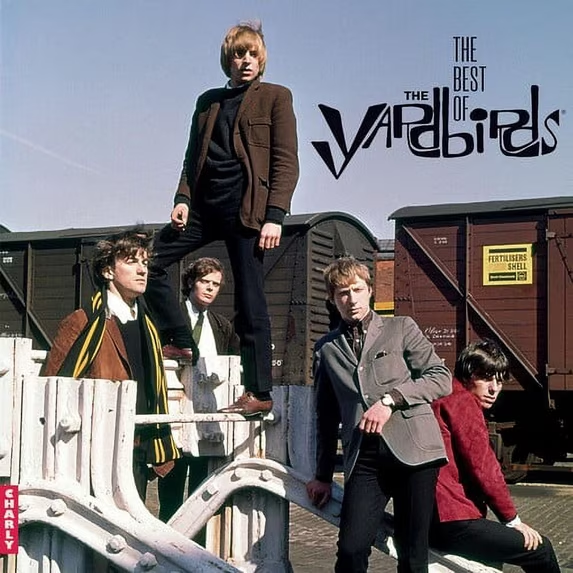
Throughout the 1970s and 1980s, numerous compilation albums introduced new audiences to the band’s recordings. Greatest hits collections such as The Best of the Yardbirds, Shapes of Things, The Yardbirds Story, and many international compilations kept their music in print. Their recordings were repeatedly remastered and reissued as public appreciation for the

band’s influence continued to grow. Critics increasingly recognized the Yardbirds not only for launching the careers of Clapton, Beck, and Page but also for their pioneering contributions to psychedelic rock, guitar experimentation, and hard rock. Archival releases became another important part of preserving the band’s legacy. Previously unreleased live performances, BBC sessions,
demos, and alternate takes gradually appeared on various anthologies. One of the most significant was the four-CD box set Train Kept A-Rollin’: The Complete Giorgio Gomelsky Productions, released in 1993. This comprehensive collection assembled the band’s early studio recordings, demos, outtakes, and rare material recorded under the guidance of their first manager, Giorgio Gomelsky.

Other deluxe editions of the original albums added bonus tracks, single versions, and previously unavailable recordings, giving fans a more complete picture of the Yardbirds’ musical evolution. Recognition of the band’s historical importance continued to increase. In 1992, the Yardbirds were inducted into the Rock and Roll Hall of Fame,

honoring their enormous influence on rock music despite their relatively brief original career. The citation acknowledged the band’s groundbreaking fusion of blues, rock, and experimental guitar techniques, as well as its extraordinary role in developing three of the greatest guitarists in rock history. Music critics have since routinely ranked the Yardbirds among the most

influential British bands of the 1960s, and their recordings continue to appear on lists of essential rock albums and songs. That same year also saw the beginning of a formal reunion. Original drummer Jim McCarty revived the Yardbirds name with new musicians, and original guitarist Chris Dreja later joined the project. Rather than attempting to recreate the past exactly,

the reunited band focused primarily on live performances that celebrated both the classic Yardbirds repertoire and contemporary blues-rock. Over the following decades, the lineup evolved several times, with vocalist and bassist John Idan, guitarist Gypie Mayo, harmonica player Alan Glen, and other accomplished musicians helping carry the band’s legacy forward.

In 2003, the reunited Yardbirds released Birdland, their first studio album of new material in thirty-five years and only their fifth official studio album. The record combined newly written songs with the band’s traditional blues foundation while featuring an extraordinary lineup of guest musicians. Former Yardbirds Jeff Beck and Jimmy Page both contributed guitar performances, marking a rare reunion of past and present members.

Additional guests included Brian May, Joe Satriani, Steve Vai, Slash, Steve Lukather, Jeff “Skunk” Baxter, and others, making the album something of a celebration of the Yardbirds’ enduring influence on generations of guitarists. Although Birdland did not become a major commercial success, critics generally praised its musicianship and viewed it as a respectful continuation of the band’s musical heritage. Since the release of Birdland, the Yardbirds have continued

performing under Jim McCarty’s leadership, with various accomplished musicians joining the lineup over the years. Chris Dreja remained involved until health issues forced his retirement, while later guitarists such as Ben King, Johnny A., and Godfrey Townsend carried on the tradition of exceptional lead guitar playing established decades earlier by Clapton, Beck, and Page.

The band has continued to tour internationally, introducing classic Yardbirds music to new generations while preserving one of the most important legacies in British rock. Today, the Yardbirds are remembered as far more than simply the band that preceded Led Zeppelin. Their innovations in blues-rock, psychedelic music, feedback, distortion,

and extended improvisation helped reshape popular music during the 1960s. Their influence can be heard in hard rock, heavy metal, progressive rock, and countless guitar-driven genres that followed. Through their original recordings, numerous greatest hits collections, archival anthologies, deluxe reissues, and the Birdland reunion album, the Yardbirds have secured a permanent place among the most important and influential bands in rock history.
Media
Further Reading


Sources
- Wikipedia “The Yardbirds” https://en.wikipedia.org/wiki/The_Yardbirds “The Yardbirds discography” https://en.wikipedia.org/wiki/The_Yardbirds_discography
- 45 Cat https://www.45cat.com/
- Allmusic “The Yardbirds” https://www.allmusic.com/artist/the-yardbirds-mn0000489303
- Discogs “The Yardbirds” https://www.discogs.com/artist/262455-The-Yardbirds
- EBSCO “Yardbirds (music group)” https://www.ebsco.com/research-starters/music/yardbirds-music-group
- Classic Bands “The Yardbirds” https://www.classicbands.com/yardbirds.html
- The Yardbirds https://www.theyardbirds.com/bio.html
- Ultimate Classic Rock “Everything You Need to Know About the Yardbirds” https://ultimateclassicrock.com/yardbirds-band-history/?utm_source=tsmclip&utm_medium=referral
